Renter & Landlord FAQ
In case you missed anything — answers to the questions we hear most about renting, listing and getting paid on liv.rent.
General
Why does liv.rent ask for so much personal information?
The information we ask for is exactly what you’ll find on a standard tenancy application. We don’t ask for anything that you wouldn’t share with a landlord or tenant if you wanted to get into a rental agreement. We take your personal information very seriously.
Why is liv.rent asking for my SIN?
liv.rent does not require your SIN. If you choose to provide it as part of getting your Trust Score, it will not be saved by liv.rent. A landlord may ask an applicant to provide them with a Trust Score, but it is not necessary to use our platform.
Once your credit check is complete and your Trust Score has been generated, your personal information is destroyed immediately. No one, including liv.rent employees, can see your data. All information is encrypted with AES-256-CTR (similar to military-grade encryption).
Trust Score is an intelligent rating system we designed to help renters clearly establish and communicate their credibility as renters. We use an Equifax credit report as part of our analysis. Using a social insurance number (SIN) is a secure way to make sure the right profile is pulled for this report.
Find out more about how getting a Trust Score streamlines renting for everyone.
What happens after I upload my ID to liv.rent?
After you have uploaded your government-issued photo ID to liv.rent, we will conduct a strict verification process. We will also ask for a selfie, which we use to match against your government-issued ID and confirm your identity. This is to protect against identity theft and related fraudulent activity.
Upon confirmation of your identity, your government-issued photo ID and all copies of authentication information will be securely destroyed immediately.
Who has access to my personal information?
No one has access to your personal information unless you have given permission for the customer support team to assist or help you manage your account. We take your personal information very seriously.
Is liv.rent legit?
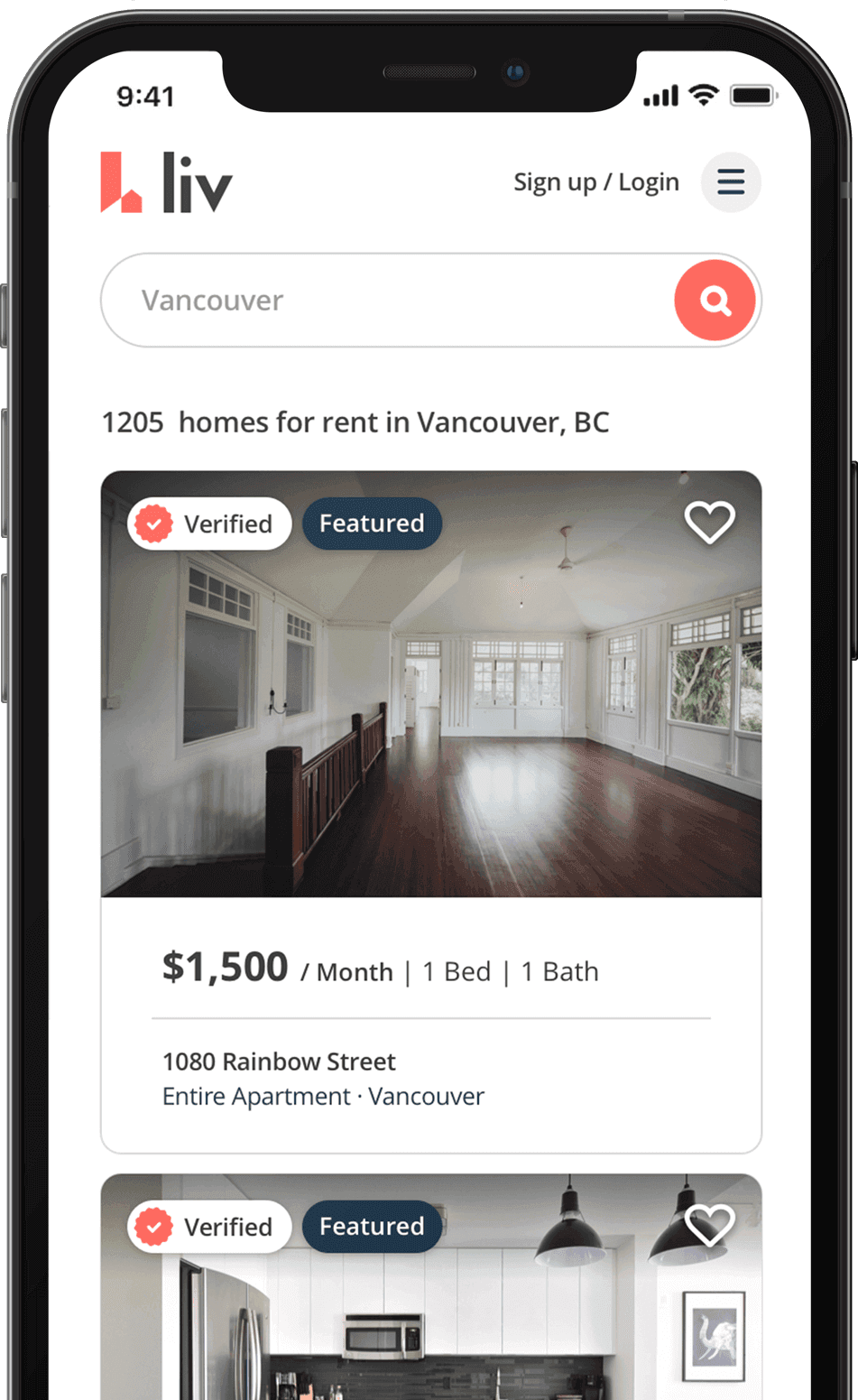
Yes, liv.rent is a Vancouver-based start-up that officially launched in August 2018. We are a rental platform that saves you time and energy by digitalizing the rental process for both renters and landlords.
Renters can:
- Search for verified rental listings
- Store rental documents
- See properties with video tours
- Send digital applications and sign tenancy agreements
- And more — see all our free renter features
Landlords and property managers can:
- Advertise rental listings
- Cross-promote across liv.rent’s syndicated channels (Facebook rental groups, WeChat, Zumper and more)
- Screen tenants with Trust Score
- Sign digital lease agreements
- Collect rent payments online
- And more — check out all of our landlord features
Plus, with liv.rent’s custom Landlord Dashboard, you can use Listing Insights to help price your rental property competitively by comparing what’s out there in the market to attract suitable, qualified tenants.
How can I contact liv.rent?
Visit our office
Suite 1A – 1601 Bayshore Dr., Vancouver, BC V6G 2V4
Reach us
Phone: (604) 593-3020
Email: info@liv.rent
We’re available
Monday to Friday, 10 a.m. to 6 p.m. PST
Saturday, 11 a.m. to 4 p.m. PST
Why is my phone number required to create an account on liv.rent?
We ask for your phone number to reduce the number of scam users signing up on our platform and to ensure your safety. Once you have submitted your phone number, we will send you an SMS message for authentication.
How does liv.rent protect my personal data?
To protect your personal data, all information is encrypted with AES-256-CTR encryption. Plus, all network traffic is secured with the HTTPS protocol. We take your personal information very seriously.
Are the contracts signed on liv.rent legally binding?
Yes, contracts signed on liv.rent are legally binding. When users enter into a tenancy agreement, they are entering into a contract directly with each other. Note: liv.rent only serves as a tool provider to facilitate the contract process, but is not a party to any tenancy agreement and has no authority to enforce the terms outlined in the signed agreement.
For more information, please refer to liv.rent’s Terms and Conditions.
Landlords
How do you advertise a rental property?
Using liv.rent is the best way to get your rental property seen by quality tenants faster. Here’s how landlords and property managers can get their listing advertised for free.
Advertise online
The best way to advertise your rental property is online. Although it is common to post on traditional classified sites, you are much better off posting on a dedicated rental property listing site such as liv.rent. With a built-in verification process, you have access to a pool of pre-screened tenants. Plus, you can evaluate the credibility of potential tenants based on their Trust Score — our intelligent rating system, powered by an algorithm that corroborates submitted tenant information.
Promote through social media
Marketing rental apartments on social media is a must. For example, Facebook rental groups and Facebook Marketplace are excellent channels to increase exposure for your rental listing. Make sure that the link to your rental listing has been optimized for social sharing (i.e. your link contains a proper thumbnail image, title and description). Certain rental property listing sites have syndicated channels that allow you to cross-promote. For example, you can easily share your rental listing to liv.rent’s syndicated channels including Facebook Marketplace, Facebook rental groups, WeChat, as well as Craigslist, Kijiji, Zumper and more.
Write an advertisement tailored to your target audience
Create a persona that reflects your ideal tenant, and identify key points that would attract this type of person. In your advertisement, make sure to highlight the unique features of your property in your introduction paragraph and provide the following information: location, amenities, utilities, pet policy, price, move-in date and lease type. Most importantly, always include quality photos.
Showcase your rental property with video tours
Uploading rental listing video tours is another way to get seen. In addition to giving prospective tenants a better spatial understanding of your property, it also helps to reduce the number of in-person viewings required, freeing up more of your time.
Price competitively
Pricing is key to attracting the right tenant and keeping your tenant turnover low. It’s important to research beforehand and find out the average rental rate in the market. To save you the time of doing that research, liv.rent’s landlord dashboard will show you the average rent for a comparable property and how your pricing compares to similar listings.
Advertise your property through offline promotion
Depending on who your prospective tenants are, you can place a rental ad in newspapers. Other options include local bulletin boards (e.g. universities, grocery stores, community centres), word of mouth, and posting a “For Rent” sign out on your property.
What are common addendums that can be added to a rental agreement?
Changes to a tenancy agreement can only be made through an addendum, which is a separate document added to the lease agreement outlining the modifications to the original terms. All changes must be in writing and be signed by both parties to make them legally binding.
Common addendums include the following:
- Pets (e.g. allow pets when the original lease prohibited them)
- Smoking (e.g. add a smoke-free policy)
- Sublet (e.g. give permission to sublet a rental unit or assign a tenancy agreement) — learn more
- Roommates (e.g. adjust the rent in response to additional occupants)
- Late fee (e.g. set the late fee amount)
- Extension (e.g. extend the end date of a lease agreement)
On liv.rent, you can easily add an addendum to your rental agreement. Vetted by industry experts, choose from an array of pre-set addendums that are customizable to suit your needs. Learn more about liv.rent’s extensive landlord features.
What information can a landlord ask for?
Landlords can ask tenants for the following information.
ID
Landlords are permitted to ask for the tenant’s name and proof of identity. Example documents: driver’s licence, passport, Canadian citizenship card, permanent resident card, or any other government-issued photo ID.
References
Landlords have the right to inquire about the tenant’s eviction history and ask for references. This includes current or previous landlords.
Income and employment verification
If a tenant is unable to provide an adequate reference, a landlord can request income and employment verification. Example documents: T4, pay stub, employment letter, bank statements, post-dated cheques.
Landlords in B.C. are allowed to collect post-dated cheques from a tenant, but this is not the case in other Canadian provinces such as Quebec. In order to request post-dated cheques, it must be stated as a term in the agreement. Additionally, when the tenant moves out, any remaining cheques must be returned.
The same documents can be requested from student tenants, but keep in mind that students may not be able to provide income verification. As an alternative, students are allowed to submit student loan financial statements. However, in most cases landlords will request a guarantor (i.e. someone who would take over payments if the renter breaks the terms in the rental contract).
How much notice do you have to give to a tenant?
Advance notice must be given if a landlord chooses to end a tenancy agreement early. However, the number of days of advance notice will vary depending on the situation.
The tenant doesn’t pay the full rent or utilities on the agreed-upon due date
A 10 Day Notice to End Tenancy can be served. If the 10 Day Notice ends the tenancy before the month ends, the tenant is still required to pay the landlord the full rent amount for the month.
The tenant breaches the residential tenancy agreement
Landlords can serve a One Month Notice to End Tenancy for the following reasons:
- Failure to pay the security or pet damage deposit within 30 days of entering a tenancy agreement
- Repeatedly late rent payments (min. 3 times)
- Breaking a material term — a term both parties have agreed to, where a breach gives the other party the right to end the agreement
- Assigning or subletting a rental unit without the landlord’s consent
- For a full list of breaches, please visit gov.bc.ca
The landlord decides to use the property
If a landlord decides to move back into the property, then a Two Month Notice to End Tenancy is required.
The landlord plans to do major construction or renovation
For any major construction or extensive renovation which requires the unit to be empty, a landlord must serve a Four Month Notice to End Tenancy.
Check out other common reasons for ending a tenancy agreement early and the proper notice to give at gov.bc.ca. And for a quick summary, read our blog post on how to end or extend a tenancy agreement.
How do I evict a tenant?
In order to evict a tenant, you must provide an acceptable reason and provide your tenant with an approved notice.
Common reasons for eviction include, but are not limited to, the following:
- The tenant didn’t pay the security or pet damage deposit within 30 days of the date required under the tenancy agreement
- Too many occupants in the rental unit
- The tenant disturbed or seriously jeopardized the health or safety of another occupant or the landlord
- The tenant put the property at significant risk (e.g. illegal activity in the rental suite that caused property damage)
For an extensive list of causes for eviction, visit Section 47 of the Residential Tenancy Act.
After confirming the reason for eviction, you must give the right amount of notice to your tenant:
- For non-payment of rent, provide a 10 Day Eviction Notice. This applies even if the tenant is a few dollars short or one day late.
- For a specific cause, provide a 30 Day Eviction Notice. Here is a list of causes that allow you to serve a One Month Notice to End Tenancy.
- For your own use of the property, you must issue a Two Month Eviction Notice.
- For any major construction or renovation, you need to provide a Four Month Eviction Notice.
Prior to issuing your eviction notice, you must have the necessary permits required by law. Once you have handed over the written Notice of Eviction, your tenant must resolve the situation within the prescribed timeline.
If it is resolved, the notice is cancelled and the tenancy resumes. However, if your tenant does nothing, then you will need to get an Order of Possession (a document to force your tenant to move out) and a Monetary Order (permission to recover unpaid rent and the filing fee) through a Direct Request.
The Residential Tenancy Branch will review the application, and one of three things will happen:
- You are granted an Order of Possession along with the Monetary Order, and can proceed with the eviction process.
- You are scheduled for a participatory hearing, which you must attend with your tenant, providing supporting evidence for your case.
- Your application is dismissed and you may or may not be allowed to apply for dispute resolution.
Want to learn more? Check out our blog post about the causes for eviction and the types of eviction notice.
What should I do if my tenant abandons the rental unit?
A tenancy is considered abandoned when rent has not been paid for at least a month and one of the following conditions applies:
- The tenant has removed their possessions
- The tenant stated that they don’t intend to return, or certain actions indicate that they do not intend to return (e.g. moving to a care home)
In the case that the tenant did abandon the rental unit, landlords can apply for dispute resolution to request compensation (e.g. unpaid rent or utilities and additional expenses). Here is a quick guide on dispute resolution.
Can landlords refuse pets?
Depending on where you are located, landlords may or may not have the right to refuse pets. In Ontario, landlords cannot refuse a tenant who has a pet. Under Section 14 of the Ontario Residential Tenancies Act, leases cannot include a “no pets” provision. If such a provision exists, then that section of the lease is void. The only exception is if the rental property is a condominium.
For most provinces like Alberta, Manitoba, Quebec and B.C., landlords can refuse pets. The only exception is if a tenant requires a service animal due to a disability. Guide and service dogs are legally allowed to live in rental properties, and landlords are not allowed to request a pet damage deposit for them.
If you’re wondering whether or not you should allow pets at your rental property, learn more about the benefits of having a pet-friendly rental and what pet policies you should include in your tenancy agreement.
What do I do if my tenant doesn’t pay rent?
If your tenant doesn’t pay rent (i.e. the full amount, on time) by midnight on the due date, then you can serve a 10 Day Notice to End Tenancy. Note: this must be a written notice.
After receiving the notice, the tenant can either pay the overdue amount within five days or dispute it. If the tenant does nothing, then an alternative option is to apply for a Landlord Direct Request. This allows landlords to claim an Order of Possession (a document that allows landlords to force a tenant to move out) and a Monetary Order (an order that allows landlords to recover unpaid rent and utilities, plus payment of the filing fee).
If you don’t have all the paperwork to complete the Direct Request process, then you can apply for dispute resolution. See what options are available if your tenant doesn’t pay rent.
Can I require my tenant to buy tenant insurance?
Although tenant insurance is not mandated by law, landlords can require renters to have tenant insurance as part of the lease agreement. However, it’s up to the tenant to agree to the term. If your tenant agrees to have insurance, then you have the right to require proof of that insurance, whether on an annual basis or as a one-off. Learn more.
What can I do if my tenant has more people living in the suite?
First of all, you need to know the difference between a guest and an occupant.
If your tenant invited guests to stay over, then your only option is to have a term in the tenancy agreement specifying how long guests can stay. However, if a dispute arises, an arbitrator may side with the tenant and dismiss your claim. It’s important to note that landlords can neither stop the tenant from having guests under “reasonable” circumstances nor charge a fee for guests.
However, if you believe that a guest has become an occupant, you can issue a One Month Notice to End Tenancy for the cause of having “an unreasonable number of occupants living in the unit”. In response, a tenant can challenge the notice through dispute resolution.
It is highly recommended that you include certain terms in your tenancy agreement, which include:
- Limiting the number of additional occupants
- Allowing the rent to vary based on an agreed amount for each additional occupant, or having all parties sign a new tenancy agreement
Learn more about the Residential Tenancy Regulation.
How do I sign a rental contract with my tenant?
You can sign your lease contract digitally through the liv.rent platform. Note: contracts are based on the standard B.C. Residential Tenancy Agreement.
In just a few clicks, you can easily pull up all of your past, current or upcoming contracts. Additionally, if you need to make changes to your lease agreement, you can select from an array of pre-set addendums that are customizable to suit your needs.
Learn more about the different liv.rent features for landlords and how they can help you manage your rental property. To get started, book a demo today.
When can landlords enter a rental unit?
In order to enter a rental unit, landlords must provide proper notice to the tenant, which involves a written note that specifies the date, time and purpose for entering the property. This must be delivered in person at least 24 hours prior to entry, and scheduled between 8 a.m. and 9 p.m. (unless you and your tenant have agreed on another time).
The purpose of entering a rental unit must be one of the following:
- To inspect the property’s condition, once per month
- To complete repairs or maintenance
- To show the property to prospective tenants or buyers
For more circumstances on when landlords can enter a rental unit, visit gov.bc.ca.
Does it cost to list on liv.rent?
It is currently free to list as many properties as you manage on liv.rent with our Essentials plan. However, chances are that if you have more than three properties, you will greatly benefit from signing up for our Business plan.
Not ready to sign up? Book an informational session instead and speak with our team members about how liv.rent can help you market and manage your listings.
How can liv.rent help me find tenants?
You can list your property on liv.rent to leverage our suggested tenants feature, and instantly connect with thousands of pre-screened tenants. For each listing that is posted, liv.rent will automatically generate a list of prospective tenants whose selected filters match your property.
Additionally, to help your property stand out, you can add professional photos and video tours to highlight specific features. Learn more about how tenants are verified and evaluated on liv.rent.
You can also have your own corporate page to showcase your portfolio, and depending on your needs, liv.rent can help you create your own personal rental website to showcase your experience. Get in touch to talk with one of our representatives today.
Since liv.rent enables multi-platform syndication, you can share your listing across different platforms including Craigslist, Kijiji, Zumper, Facebook Marketplace and more. You can also be part of our Sponsored Listing program to boost traffic to your rental listing. Learn more about liv.rent features for landlords.
How do I check a potential tenant’s credit score?
To check a potential tenant’s credit score, you can use our Trust Score intelligent rating system.
This involves a standard credit check conducted by Equifax, which provides a comprehensive picture of the renter’s financial credibility based on payment history, credit utilization, bankruptcy index and so forth.
In addition to the credit check, liv.rent uses a powerful algorithm to combine a renter’s financial record with public and submitted data to assign a Trust Score that allows you to evaluate a renter’s reliability and credibility.
How does the Trust Score compare to other credit check reports?
Unlike other credit check reports, Trust Score allows for a more comprehensive picture of potential tenants. Using AI and a powerful algorithm, this intelligent rating system takes into account a renter’s financial record as well as public and submitted data (e.g. LinkedIn profile), which then assigns a Trust Score to every renter.
This offers landlords a more secure and accurate measure of a potential tenant’s suitability, and simplifies the tenant selection process without you having to check manually. Learn more about Trust Score.
How do I collect rent from my tenants?
There are two ways to use liv.rent to collect rent payments from your tenants.
Option 1
If your tenant is paying by Visa, Mastercard or American Express, then you can accept payments through Stripe. All you need to do is connect your Stripe account with liv.rent; once your tenant makes a payment, it will be deposited into your Stripe account, which pays it out to your bank account.
Option 2
If your tenant chooses to pay by UnionPay or bitcoin, then you can set up a direct deposit by putting your bank account information in your liv.rent profile.
Do I have to pay any service fees if I collect rent online using liv.rent?
If you’re accepting payments with Stripe, then the service fee that Stripe charges for each transaction will be passed on to your tenant. However, landlords may encounter additional charges from Stripe, so always check your Stripe account to see what fees have been applied.
For tenants paying with UnionPay or bitcoin, as a landlord you will have to pay a flat service fee of $3 CAD per transaction.
These fees will be labelled as “Payout fee” on your payout details page.
If my renter underpaid, how do I receive the unpaid amount?
With the Pay by Bitcoin feature, there may be extremely rare circumstances where, due to exchange rate fluctuations, a renter has underpaid their rent.
In case of an underpayment, liv.rent will send a supplementary payment request to the renter stating the outstanding balance. Once the renter has paid the remaining balance and liv.rent has confirmed that the underpayment was corrected, the landlord will receive the full payment.
For more information, you can refer to Section 4.10(f) of our Terms and Conditions.
If my renter overpaid, how do I refund their money?
With the Pay by Bitcoin feature, there may be extremely rare circumstances where, due to exchange rate fluctuations, a renter has overpaid their rent.
In case of an overpayment, landlords will need to contact their renters directly and provide a refund or credit based on an agreed method. liv.rent will not take part in this refund process, and any overpaid funds are transferred directly to the landlord.
For more information, you can refer to Section 4.10(g) of our Terms and Conditions.
Under what circumstances is liv.rent responsible for refunds?
For rare cases of invalid or cancelled payments, liv.rent may issue a refund. Please view Sections 4.10(h) and 4.10(d) of our Terms and Conditions for the applicable refund situations.
If the situation applies, please ask your renter to submit a refund request to support@liv.rent. liv.rent will then review the request and will issue a refund if the request is deemed valid.
Since renters can now pay with Bitcoin, can I receive rent in Bitcoin?
Currently, landlords do not receive payments in bitcoin. When the renter pays with bitcoin, it is transferred and deposited by liv.rent in Canadian dollars into the landlord’s bank account. Learn more about bitcoin rent payments on liv.rent by checking out our blog.
Do I receive rent payments right away?
If you’re accepting payments with Stripe, then you will receive your rent based on your account’s payout schedule. In most cases, it takes seven calendar days for rent payments to be received. Learn more about receiving payments through Stripe.
Payments made with UnionPay will typically take three to five business days.
For payments made with bitcoin, the processing time will vary. Please check your dashboard for the payout schedule. liv.rent’s current payout schedule for landlords is every Tuesday.
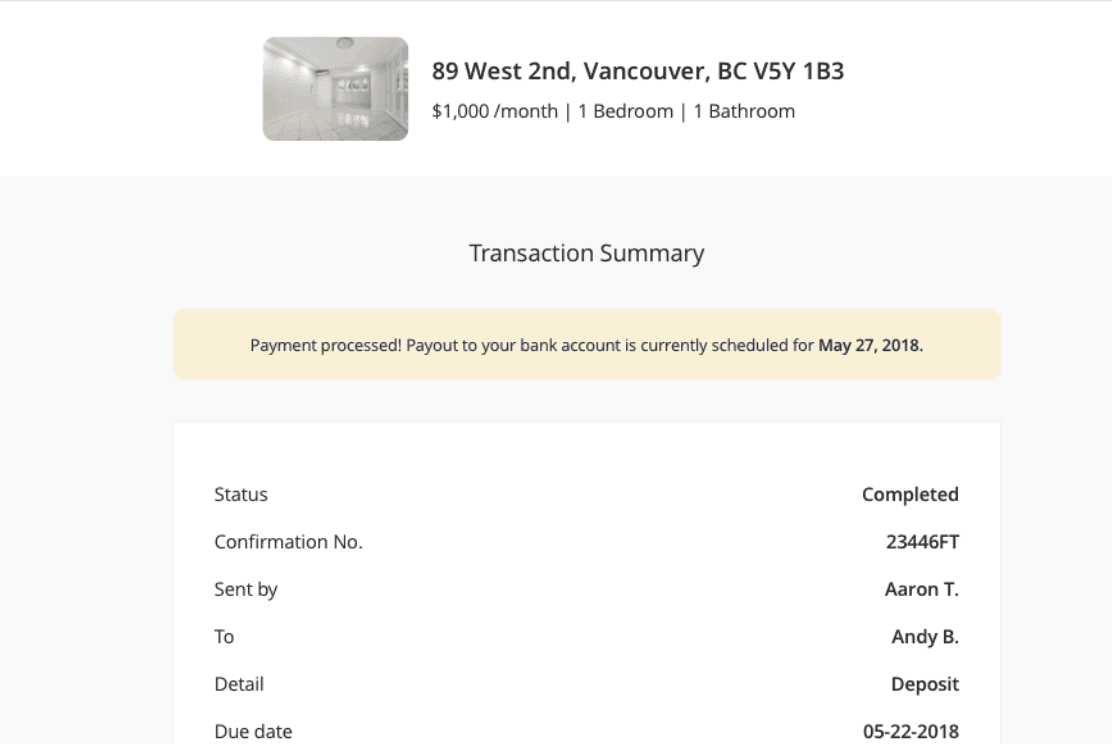
Why is there a payout fee?
The payout fee is collected to cover the costs of facilitating the transaction and any additional administrative costs.
Renters
When should I pay my deposits?
You should only give your security deposit, also known as a damage deposit, at the time of signing or after a lease agreement has been signed. The deposit can be no more than half of the first month’s rent and must be paid within 30 days of entering into the tenancy agreement. Once you have paid your deposit, the tenancy is established. In other words, you can’t move in somewhere else and your landlord can’t rent it out to someone else.
Rental guide: how rent works in Canada — a provincial comparison.
What do I do if my landlord refuses to pay my deposit back?
If your landlord refuses to return your security deposit, then you can apply for dispute resolution requesting that your deposit be returned.
However, before applying for dispute resolution, make sure you have complied with the following rules:
- Provided a forwarding address to your landlord, in writing.
- Thoroughly cleaned your unit and removed all belongings.
- Participated in the move-out inspection and completed the move-out condition inspection report.
Once your tenancy has ended and you have complied with all the rules, your landlord must return your deposit within 15 days of you moving out. An exception to this is when your landlord requests compensation for damage or applies for dispute resolution to request keeping part of the deposit.
For more information, read our ultimate guide on security deposits.
Can landlords refuse pets?
Depending on where you are renting, landlords may or may not have the right to refuse pets. In Ontario, landlords cannot refuse a tenant who has a pet. The only exception is if the rental property is a condominium.
However, for most provinces like Alberta, Manitoba, Quebec and B.C., landlords can refuse pets. The only exception is a tenant with a guide or service animal, and landlords cannot request a pet damage deposit in this case.
Additionally, if pets are allowed, landlords have the right to restrict the kind or breed, the size and the number of pets. Keep in mind that it is quite common for landlords to allow small pets but not large ones. Learn more at gov.bc.ca.
Search on liv.rent to find pet-friendly rentals in Vancouver, Burnaby, Richmond, Surrey and more. Simply apply the “Pet Policy” filter.
Do I need to include my roommate on my lease agreement?
Depending on which roommate setup you have, the person living with you may or may not need to be on the lease agreement. There are three types of setup for roommates and occupants:
- Co-tenants are roommates who share a single tenancy agreement. In this case, the name of the co-tenant must be on the lease agreement. Co-tenants are jointly responsible for everything related to the tenancy. If the landlord issues an eviction notice because the full rent was not paid on time, then this will apply to everyone.
- Tenants in common have separate tenancy agreements with the landlord (the landlord rents out individual rooms in a house under separate agreements). In this case, the person living with you must be on a lease agreement that is separate from yours. If anything goes wrong on their agreement, you won’t face any legal implications.
- Roommates and occupants do not rent from the landlord. Instead, they rent from the tenant. In this case, the person living with you does not have to be on the lease. However, in this kind of arrangement, the roommate or occupant will not be protected by the Residential Tenancy Act. Also, for any disputes, they cannot use the Residential Tenancy Branch (RTB) dispute resolution system. They can only settle through Small Claims Court, the Civil Resolution Tribunal or the B.C. Supreme Court.
It is highly recommended that you draft a roommate agreement to set expectations and ground rules. Learn more about finding a roommate and download the free roommate agreement template.
What are considered emergency repairs on a rental unit?
When the tenant’s health or safety is impacted or the property is put at risk, it would be classified as an emergency repair. By law, landlords are responsible for handling and paying for all emergency repairs.
The following situations would be considered emergency repairs:
- Major leaks in pipes or the roof
- A broken primary heating system
- A damaged plumbing system
- A malfunctioning electrical system that can create a risk of fire or electrocution
- Defective locks that make the unit insecure
Your landlord is required to provide an emergency contact number either in writing or by posting it in a common area. If you encounter an urgent repair that meets the definition of an emergency, you should try calling the emergency contact at least twice, leaving a reasonable amount of time between each attempt.
If there is still no response, then you can arrange to have the repairs done at a reasonable cost. Afterwards, your landlord must reimburse you for the emergency repair. In order to receive reimbursement, you must submit all receipts and a summary documenting your process. Make sure to keep copies of your research effort to show that you did your best to find a fair price.
Check out the following blog post for a complete list of landlord and tenant responsibilities.
What information can a landlord ask me for?
Landlords can ask for the following information:
- Credit check
- References
- Salary
- Post-dated cheques
Protect yourself and learn more about what information landlords can and cannot ask for.
Prospective landlords may request a credit check to assess your ability to pay rent. To run a credit check, you must provide your name, address and date of birth. Landlords may also ask for your driver’s licence, passport or social insurance number (SIN). Although this information is not needed, it will allow the landlord to obtain a more detailed report from the organization providing the credit check. Learn about Trust Score, our intelligent rating system for establishing your credibility as a renter.
Note: landlords are required to comply with the Personal Information Protection and Electronic Documents Act (PIPEDA). As a result, landlords must provide an explanation when they request certain documents. They are not allowed to collect more information than what’s needed for the stated purpose.
Who’s responsible for fixing things in a rental?
Tenants are responsible for repairing damage caused by someone living in the unit (e.g. roommates) or visiting it (e.g. guests). This also applies to damage caused by pets. For all other rental repairs, landlords are responsible for fixing them. However, tenants are responsible for notifying the landlord if something needs to be repaired.
Additionally, tenants are required to meet the minimum standard of health and cleanliness for the unit and surrounding areas such as the hallway, yard and laundry facility.
Here are some useful resources:
Who is responsible for snow removal at a rental property?
In B.C., responsibility for snow removal depends on the rental property type. For a multi-unit building, landlords are responsible for snow removal. On the other hand, for a single- or multi-family dwelling or townhouse, renters are responsible for shovelling snow.
In Ontario, landlords are responsible for snow and ice removal. Under section 26 of Ontario Regulation 517, landlords are obligated to maintain exterior common areas, which includes removing weeds and shovelling snow. Even if the residential lease has a clause that requires the tenant to remove snow and ice from a rental property, this is not enforceable because landlords cannot transfer this responsibility to the tenant.
Learn more by viewing our complete list of landlord and tenant responsibilities.
What do I do when an appliance breaks down?
Landlords are responsible for appliances in a rental property, except for appliances that are not stated in the rental agreement. As a result, the basic maintenance of appliances, as well as replacement or repairs related to standard wear and tear, falls under the landlord’s domain. However, tenants are responsible for repair costs if they caused the damage.
Can a landlord make a tenant pay for repairs?
If the damage was not caused by the tenant, their pets or their guests, then landlords cannot make a tenant pay for repairs. Likewise, a tenant cannot make the repairs themselves and charge the landlord for the costs unless they received a written agreement from the landlord beforehand.
For regular or routine repairs, tenants must request in writing — describing the problem and providing the landlord a reasonable amount of time to fix it. If the landlord refuses to fix the problem, then the tenant can apply for dispute resolution to obtain an order requiring the landlord to make the repair, and apply for monetary compensation.
For emergency repairs, tenants must reach out to the emergency contact at least twice, leaving a reasonable amount of time between each attempt. If there is still no response, then they can arrange to have the repairs done at a reasonable cost and request reimbursement from the landlord. In order to receive payment for the repair, tenants must submit all receipts and a summary documenting the research process, showing their best effort to find a fair price.
What happens if I pay my rent late?
Landlords can evict you for paying rent late. In accordance with the Residential Tenancy Act, your landlord can give a 10 Day Notice to End Tenancy if rent or utilities were not paid in full by midnight on the due date.
If you pay the outstanding amount within five days of receiving the notice, then the notice is cancelled and your tenancy continues.
Note: even if you did not pay the rent on time, landlords do not have the right to remove or limit access to any of your personal property unless they received written permission from the court or they followed the procedure for abandoned property.
Do I need to purchase tenant insurance?
No, tenant insurance is not mandatory. However, landlords may request it as a condition in the lease.
Although you are not obligated to get tenant insurance (also known as renter’s insurance), it is highly recommended because it can end up saving you a lot of money in the long run. For instance, if another tenant or a neighbour caused an accident that resulted in damage to your personal property, you are responsible for covering the cost to repair or replace your items.
Tenant insurance can cover the damage and losses to your personal property. Read on to learn more about tenant insurance and its benefits.
Can a landlord ask for another security deposit?
No, landlords cannot ask for an additional security deposit. In B.C., landlords can only request one security deposit and one pet damage deposit per tenancy agreement.
The security deposit (or damage deposit) can be no more than half of the first month’s rent, and is used to cover any damage to the rental unit. Likewise, a pet damage deposit can be no more than half of the first month’s rent, regardless of the number of pets allowed.
Learn more about security deposits in B.C.
In Ontario, instead of a security deposit, landlords can request a rent deposit (also known as last month’s rent). On a yearly or monthly rental, the rent deposit can be no more than one month’s rent. On a weekly rental, the rent deposit can be no more than one week’s rent. Unlike a security deposit, which would be returned at the end of a lease term (provided there was no damage), the rent deposit is used for the final period of rent. Landlords may not use the rent deposit for damage or other costs.
Can a landlord charge me a key deposit?
A key deposit is legal in Ontario. However, in other Canadian provinces, such a deposit is either not allowed or considered part of the security deposit.
In Ontario, the key deposit can be no more than the actual cost to replace the keys and must be refundable — landlords must give back the deposit when their tenant returns the keys.
In B.C., landlords cannot charge a fee for the tenant’s primary key, which serves as the only means of getting into the rental property. However, a refundable fee can be charged for additional keys or access devices, like a fob.
Are landlords allowed to increase rent?
Yes, landlords are allowed to increase rent, but the requirements vary by province.
In B.C., landlords must issue a Notice of Rent Increase a minimum of three months in advance of the proposed increase taking effect. In addition, landlords can only increase rent once in a 12-month period and cannot exceed the maximum allowable rent increase.
Similar to B.C., landlords in Ontario must also provide the tenant with a written notice stating their intention to raise rent three months in advance, and are restricted to once every 12-month period.
How do I end my lease early?
In order to get out of a lease early, you must provide your landlord with written notice of your intent to terminate the fixed term tenancy agreement earlier than the end date. Afterwards, both you and your landlord must sign the Mutual Agreement to End Tenancy form and each keep a copy.
If you decide to end your lease early, be prepared to reimburse your landlord for costs associated with re-renting the unit (e.g. advertising or lost rent). As an alternative, you can also ask your landlord for written permission to help them find a new renter, either through subletting or assigning the tenancy agreement to someone else.
Are landlords allowed to come into my rental property without notice?
In order to enter the rental property, landlords must serve a notice of entry at least 24 hours in advance, but no more than 30 days before the effective date. The notice must state the date, time and purpose for entering. In addition, the time scheduled for entry must be between 8 a.m. and 9 p.m., unless another time is agreed upon. It’s important to know your rights as a tenant.
Does it cost to rent on liv.rent?
No, liv.rent is completely free for renters. By signing up, you can enjoy all of our features at no additional cost:
- Verified landlords, to rent safer
- Renter Resume, to apply to multiple listings with one account
- Video tours
- Trust Score, to showcase your credibility as a renter
- Digital contracts, to paperlessly secure your rental
What does a verified listing or verified landlord mean, and how do I know if a landlord or listing is verified?
A verified listing or verified landlord on liv.rent means that our team has manually validated the information of a rental listing or an individual landlord from external sources (including but not limited to government-issued ID, land titles or official documents such as a business licence). This is used to confirm the validity of the rental listing and the identity of the landlord.
If a landlord or listing is verified, you will see a verified badge (checkmark icon) next to the address of the listing or the name of the landlord. Learn more about liv.rent’s verification process.
How do I apply to a rental listing?
In order to apply to a listing on liv.rent, you need to first sign up and complete your online renter resume by providing basic information such as name, date of birth, email, phone number and preferred language.
Similar to how landlords are verified, renters also go through a verification process which contributes to the Trust Score, our rating system used by landlords to evaluate your credibility as a renter. After completing your resume, you no longer have to worry about filling in any additional forms — you can apply to multiple listings at once.
Why is my Equifax score different from my Trust Score?
Your Trust Score is not the same as your Equifax score, because Trust Score uses a powerful algorithm that corroborates information from multiple sources — like your LinkedIn profile, references and financial records — to assess your credibility as a renter. It provides a more secure and accurate measure of your reliability.
Why is my Trust Score so low?
Your Trust Score may be low due to missing information in certain sections of your profile.
To improve your Trust Score:
- Complete your profile
- Complete liv.rent’s verification process
- Upload additional financial documents (e.g. pay stubs, employment letter, tax slips and more)
Check out this blog post on how you can improve your Trust Score.
How do I pay rent online?
You can pay rent online through liv.rent, either in-app or on the web. There are several payment options you can choose from, including Visa, Mastercard, American Express, UnionPay and bitcoin.
Learn more about how you can pay rent through liv.rent to your landlord.
Are there service fees associated with paying rent online through liv.rent?
If you’re paying by credit card — Visa, Mastercard or American Express — then you will have to cover the standard processing fee charged by Stripe, the platform used to facilitate these payments.
If you pay with UnionPay, you will be charged a standard processing fee of 2.5% per transaction.
If you choose to use liv.rent’s Pay by Bitcoin feature, then you will pay a nominal, non-refundable fee of 0.5% per transaction. This is charged by liv.rent to cover the costs associated with facilitating these transactions. Additionally, you will have to cover any processing fees charged by the cryptocurrency network that you use.
These fees will be labelled as “Processing fees” on your payment details page.
Why do I have to pay processing fees on liv.rent?
Most of these processing fees are charged by third parties like Stripe and UnionPay, which liv.rent has no control over. You will see the same fees being applied on other rent collection platforms.
For liv.rent-specific fees, including the processing fee for bitcoin payments, we only charge when necessary. These fees are collected to help facilitate the transaction and to cover administrative costs.
Why can’t I select a payment option?
To pay your rent through liv.rent, you will have to wait for your landlord to send a payment request, which will appear in your chat timeline. Once you receive the notification, click on the request and follow the payment flow. This can be done in-app or online.
You should then be able to see a drop-down menu with three payment options: Visa/Mastercard/American Express, UnionPay, and Pay by Bitcoin.
Select your payment option and follow the instructions.
The payment request says I’ve underpaid — what does that mean?
This may occur if you pay with bitcoin, since fluctuations in the exchange rate can affect your payment amount.
In other words, the exchange rate, which is calculated at the time of payment, may result in a paid amount that is less than the requested amount. In this case, you would receive a message saying that you have underpaid. To resolve it, all you need to do is pay the remaining balance.
For more information on underpayment, you can refer to Section 4.10(f) of our Terms and Conditions.
If I overpaid, how can I request a refund?
This may occur if you pay with bitcoin, since fluctuations in the exchange rate can affect your payment amount.
In other words, the exchange rate, which is calculated at the time of payment, may result in a paid amount that is greater than the requested amount.
Since the entire payment is converted into fiat currency and transferred to the landlord — and liv.rent does not hold on to any overpaid funds — you will need to contact your landlord directly to arrange a refund or credit based on an agreed method.
For more information on overpayment, you can refer to Section 4.10(g) of our Terms and Conditions.
Can I get a refund if I made a mistake in my rent payment?
Contact your landlord directly to make arrangements.
Under what circumstances do I contact liv.rent for a refund?
For rare cases of invalid or cancelled payments, liv.rent may issue a refund. Please view Sections 4.10(h) and 4.10(d) of our Terms and Conditions for the applicable refund situations.
If the situation applies, renters may submit a refund request to support@liv.rent. liv.rent will then review the request and issue a refund if it is deemed valid.
For information on how the refund amount is calculated, refer to Section 4.10(j) of our Terms and Conditions.
What if I want to pay rent online through liv.rent, but my landlord is not on your platform?
If your landlord is not on liv.rent, we can get them onboarded right away. Ask them to contact us at support@liv.rent. We can help them set up a free account and provide a quick tour of all the different landlord features — including electronic rent collection.
What should I do if I think I got scammed by my landlord?
Scams and fraudulent activity are remarkably uncommon on the liv.rent platform thanks to our extensive verification process. For an added measure against rental scams, we verify both our listings and our landlords. Listings are verified by official documents or directly through mail, whereas landlords are verified by government-issued ID or business licence. So, during your search, make sure to look for the verified checkmark next to the listing and the landlord profile.
However, if you believe you have been the victim of a scam or suspect fraudulent activity, then contact us immediately at support@liv.rent and we will begin an investigation.
Since all correspondence between you and your landlord — including payment requests — is stored in your chat timeline, you will have a record of everything, which can be used as supporting evidence.
Rental solutions at your fingertips.
Download the app to expedite and streamline your rental process, all on one platform.