


For many Americans looking to relocate, Canada is one of the top choices. Not only do we share a border, but we also share many values and a similar standard of living; however, the two countries differ in other ways that make Canada an attractive destination for renters in particular. In this article, liv.rent explores the ins and outs of coordinating a move to Canada from US. From legal requirements to understanding the rental market, there’s a lot Americans need to know before settling into their new Canadian home. Whether you’re relocating for work, study, or lifestyle, this guide will walk you through every step—from planning your move to comparing rental listings in Canada and leasing your first apartment or home. It also includes the latest rental statistics to help you make informed decisions.
Understanding Moving to Canada from the US
Depending on whether you want to move to Canada permanently or temporarily, the process varies either way it’s a good idea to create a budget for moving to Canada. If you want to come as a student or temporarily, you must apply for a visitor’s visa and a student visa or work permit if you plan to study or work in Canada.
Legal Requirements for US Citizens
Canada has several legal requirements that both landlords and tenants must follow under provincial Residential Tenancy Acts:
- Age Requirement: Most provinces require tenants to be at least 18 years old.
- Identification: Valid government-issued ID (passport, PR card, or driver’s license) is required.
- Lease Agreement: A written lease is usually mandatory for rentals longer than 12 months; it outlines rent, term, and responsibilities.
- Security Deposit Rules: Most provinces limit deposits to one month’s rent or less and require it to be held in trust.
- Tenant Rights: Laws protect tenants from illegal eviction, discrimination, and unfair rent increases.
- Landlord Obligations: Landlords must provide safe, habitable housing and adhere to maintenance standards.
- Americans should be aware of these rules to ensure a smooth leasing process and avoid any legal complications.
Platforms like liv.rent help newcomers comply with these regulations by providing verified listings and transparent lease agreements.
Types of Rentals Available
- Apartments and condominiums
- Detached houses or townhouses
- Shared accommodations or co-living spaces
- Short-term furnished rentals for newcomers
Benefits for US Citizens Moving to Canada
Americans moving to Canada enjoy several benefits:
- Access to universal healthcare (once eligible)
- Ability to open Canadian bank accounts
- Access to social services and government programs
- Exposure to a high-quality education system for families
Other Important Considerations
Health insurance: Essential during the initial months before healthcare eligibility
Moving insurance: Protect your belongings during transit
Cultural adaptation: Learn about Canadian customs, tenant rights, and community norms
Can a US citizen live in Canada?
Yes, US citizens can get residency in Canada. You can live in Canada as a U.S. citizen provided you have the correct work visa or permanent residency status. Canada does not require Americans to renounce their American citizenship. If you do decide to go ahead with Canadian citizenship application, you can remain a dual citizen.
Can I rent an apartment in Canada as a US citizen?
Renting in Canada as an American citizen is definitely possible provided you follow the proper steps. An American citizen can rent in Canada as long as they already have a work visa, student permit or permanent residency. Landlords may require additional paperwork to prove your ability to pay rent, though, as well as potentially asking for a guarantor to co-sign the lease to safeguard their rental income.
Can you rent in Canada without a visa or study permit? Only on a short-term basis, such as a vacation rental. We cover more tips for how to rent an apartment in Canada as an American throughout the rest of this guide.
How to Secure a Place to Rent before Coming to Canada: Step by Step Guide
Before you embark on a search for a Canadian home, make sure you have the right documentation ready. Landlords will ask you for financial documents that prove your financial viability. These might include letters from your bank, your employer or your government revenue agency. They will also want reference letters from previous landlords and/or employers.
>> Recommended Reading: Rent In Canada: How To Secure A Home Before Coming To Canada
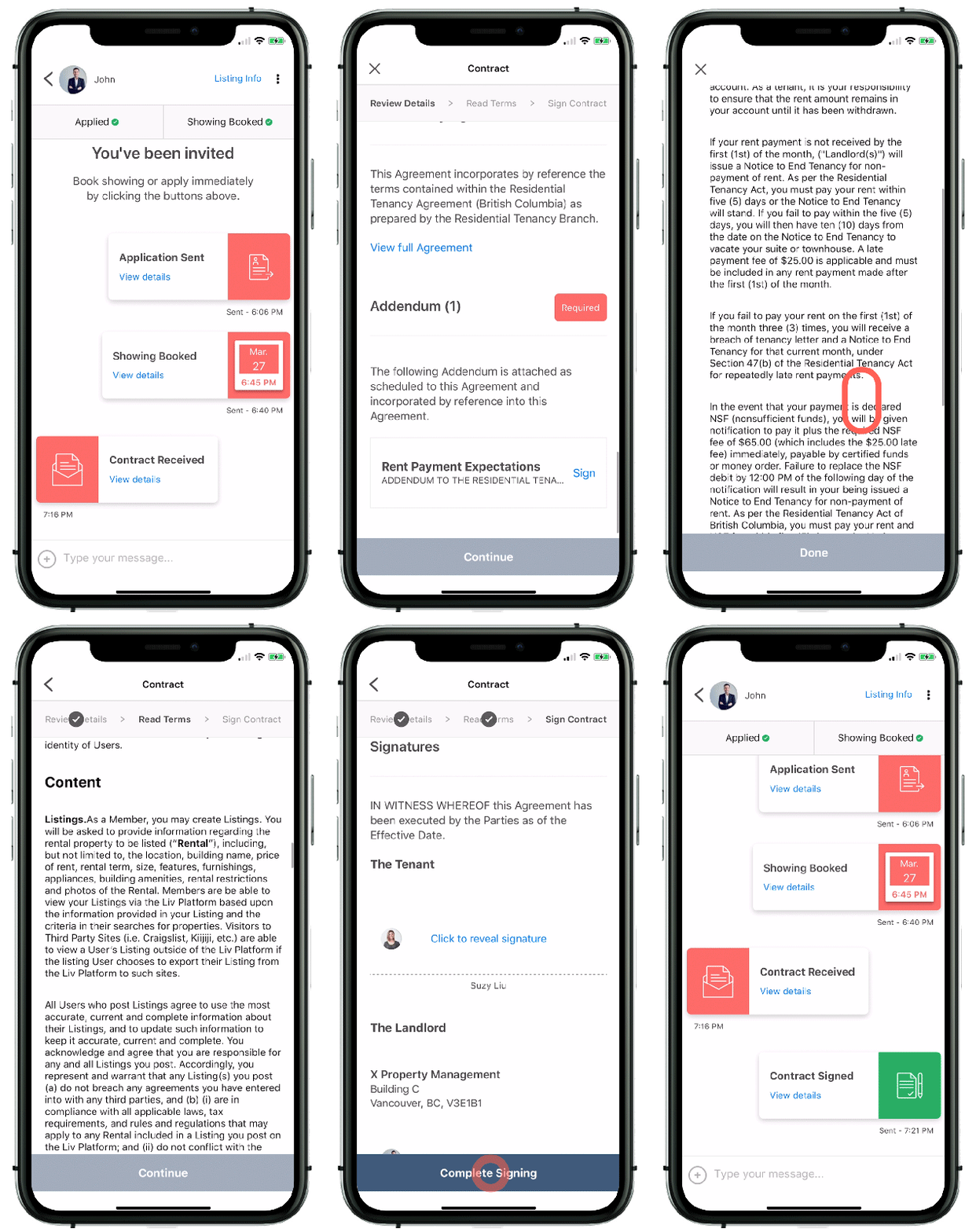
Applying through liv.rent
If you live in the U.S., looking for an apartment in Canada poses some unique challenges. Thankfully, liv.rent makes finding a home easier regardless of where you might be physically.

On liv.rent, we guide you through the entire application process to protect our users’ privacy. When submitting an application, renters must submit a variety of documents to verify the following:
– Government-issued ID
– Income/employment
– Social verification
– Credit
This information is temporarily stored until the verification process is complete, and compiled into our comprehensive Trust Score. The Trust Score is a comprehensive tenant screening report landlords on liv.rent can use to evaluate tenant credibility and reliability.
You can read more about the Trust Score and how to complete yours here.
Check out some of our other posts designed to help tenants:
BC Residential Tenancy Act Explained
Residential Tenancy Act: Dispute Resolution
Setting Up Utilities
Complete your liv.rent renter profile
Your renter profile serves as your application. You only need to complete it once and then submit it to all the properties that interest you. The more information you provide, the more likely you are to secure your preferred rental. Here are the steps to follow:
1. Select “I do not live in Canada”
We understand that credit ratings do not cross national boundaries so we have given users the option of selecting “I do not live in Canada” when creating their renter profile. This will explain to prospective landlords why a credit score is not available for you.
NOTE: Secure a Canadian cell phone number as soon as possible. Having an active local number in advance will help you open utility accounts, bank accounts, and more; in addition, you may be asked for a domestic number at your point of entry.
2. Select “I’m a first-time renter”
If you are renting for the first time and don’t have any landlord references, select the option “I’m a first-time renter”. Also, choose this if your landlord references are from your home country, letting your landlord know this is the case.
>> These are challenging times. To help you navigate your move, check out our article: Moving to Canada during the COVID-19 Pandemic
3. Attest for your Pets
If you have pets, include a picture of them and send additional information via chat (videos, testimonials from your current landlord or even from a dog trainer etc.) – anything that shows your pet is well-behaved.
4. Upload Financial Documents
If you do not have an active letter of employment or job offer in Canada, this is the most important section for you to complete. Upload bank statements showing you have at least one year’s worth of rent in your bank account.
5. References
If you do not have employment or landlord references, cite an employer, teacher, or immigration agency as your reference; essentially, choose someone who can attest to your reliability and credibility as a tenant.
6. Treat the application like an immigration or job application
Just as you would try to prove your worth as a contributing member of Canadian society or suitable employee, do the same for your landlord. Ask yourself why the landlord would choose you over other candidates and then demonstrate why.
- The biggest differences in work life pertain to the benefits employees receive.
- In Canada, workplaces are legally obligated to offer a minimum of 2 weeks vacation. Most companies offer more than the required minimum. After a few years of employment, the number goes up to 3 weeks. In the U.S., by contrast, paid vacation time is not legally required.
- Maternity and Parental Leave are far more generous in Canada with most mothers typically taking a year’s leave or sharing their permitted leave with their partners.
Living in Canada vs USA
The differences between Canada and the US may not be obvious at first but there are some key differences that shape Canadian society and differentiate it from the US.
Government
- Starting from the top, while the U.S. is led by a president, Canada is led by a prime minister and Queen Elizabeth is technically (though not practically) the Head of State.
- Canada is a parliamentary system whereby we elect Members of Parliament to represent our riding (or region) in Ottawa, our capital. We do not vote directly for our Prime Minister but rather for our local representative from the same party of our desired Prime Ministerial candidate.
- Canada has five major political parties: Liberals, Conservatives, NDP, Green Party and the Bloq Quebecois from our French-speaking province, Quebec.
- In general, Canada’s entire political spectrum is to the left of the U.S. with all parties believing in the value of a public healthcare system, the value of immigration and other social safety nets that ensure a more equitable society.
>> Recommended Reading: Cost of living comparison: 6 major Canadian cities
Immigration & Diversity
- Generally speaking, immigration isn’t as politically charged a subject as it is in the U.S. Canadians recognize that their economic well-being is dependent on immigration due to low birthrates and a population of only about 39 million (roughly 1/10 the population of the U.S).
- Canada prefers to call immigrants “New Canadians” recognizing their intention to stay and offering them a clear path to citizenship.
- Much of the focus is on family reunification – bringing in parents, spouses, children or siblings who live abroad.
- Newcomer centres and services for immigrants provide support to help you transition to your new life in Canada.
- 1/5th of the population is foreign-born making for a dynamic, diverse, multi-cultural country.
Work

>> Recommended Reading: So You Want to Study (& Work) in Canada
Healthcare
- Canada enjoys the benefits of universal healthcare. Once you are a Permanent Resident or citizen, you register provincially for public healthcare insurance and pay a nominal fee that varies from province to province; you are then eligible to receive free basic healthcare anywhere in Canada. This means you can walk into a clinic or hospital and receive medical attention without fear of being turned away.
- This government health insurance gives you access to basic medical services. However private insurance, often provided by employers, will help cover costs for prescription medicine, dental care, eyeglasses, physiotherapy, massage therapy, and ambulance services.
- There is a shortage of doctors in many parts of Canada so finding a permanent family doctor may be a challenge. Thankfully, you can rely on the medical services provided by clinic doctors until you can secure a permanent doctor.
Education
- Canada has the largest percentage of adults seeking higher education. According to the OECD, 55% of Canadians between 25-64 years have some level of college education compared to 33% of Americans.
- Canadians view education more as a right than a privilege.
- Canadian Universities are fewer and thus, typically larger than American universities.
- Greek life (fraternities and sororities) exists at Canadian universities but it is not as ubiquitous as in America.
Getting a study permit in Canada
As of August 2025, the Canadian government has confirmed that the international student cap introduced in January 2024 is continuing into 2025. There is still a cap on new international study permits, setting a target of 437,000 new study permits issued, a further 10% reduction from the 2024 level.
>> Recommended Reading: Guide for international students moving to Canada
Language
- Canada has two official languages – English and French as England and France co-founded the country.
- French is spoken primarily in Quebec but there are Franco-Canadian communities in every province.
- French Immersion schools are federally funded and public. As such, Canadians across the country can choose to educate their children in these schools that promote bilingualism at no extra cost.
- All packaged products display English and French text and ingredients.
- English is still the dominant language in all provinces other than Quebec so Americans are not compelled to learn French unless they want to.
Measurement
- Canada, like most of the world, uses the metric system. Thus, our measurements are in kilometres, metres, kilograms, grams, litres etc.
- Our temperature is in Celsius as opposed to Fahrenheit.
Cultural differences Canada vs USA
Canadian culture is challenging to define as it does vary somewhat from region to region. The West Coast (British Columbia), the Prairies (Alberta, Saskatchewan, Manitoba), Central Canada (Ontario), Quebec, the North (Yukon and Northwest Territories) and the Maritimes (Nova Scotia, Prince Edward Island, New Brunswick, Newfoundland) all contribute their own flavour and nuance to the Canadian cultural landscape. Similarly, urban Canadians and rural Canadian bring something different to the cultural discussion as well.
- In general, our culture does embody artistic, culinary, literary, comedic, musical, political and social elements that are all the product of our diverse, tolerant society.
- Indigenous peoples of the First Nations, Inuit, and Metis have inhabited Canada for thousands of years, and are only recently a being recognized and celebrated. The government is taking strides to pay for reparations, negotiate treaties and laud their contributions to Canadian society and culture. This is in contrast to the US where America’s indigenous people have made far fewer legal strides.
- From music legends like Glenn Gould, Oscar Peterson, Leonard Cohen and Neil Young to pop stars like Drake, The Weeknd and Justin Bieber, literary giants like Margaret Atwood, Alice Munro, Michael Ondaatje and Yann Martell or the brilliance of Canadian Comedy shows, that highlight our self-deprecating, dry sense of humour, like Kids in the Hall, Trailer Park Boys or most recently Schitt’s Creek, Baroness Von Sketch Canadian culture is recognized globally.
- Or artistic greats like the Canadian landscape painters known as the Group of Seven who painted from 1920 to 1933 (Franklin Carmichael, Lawren Harris, A. Y. Jackson, Frank Johnston, Arthur Lismer, J. E. H. MacDonald, and Frederick Varle), Emily Carr, or contemporaries like Douglas Coupland, Rodney Graham, Gordon Smith, Attila Richard Lukacs.
Sport
- Hockey is Canada’s favourite professional sport. Hockey greats like Wayne Gretzky, Gordie Howe, and Sidney Crosby are recognizable names across Canada and major cities with NHL franchises (Vancouver, Edmonton, Calgary, Toronto, Montreal) always have their own local hockey celebrities as well (43% of NHL Players are Canadian).
- Basketball popularity is on the rise. The 2019 Toronto Raptors win further boosted Canadian interest in the NBA (Toronto has the only Canadian NBA team).
- Canada also has its own football league called the CFL (Canadian Football League) with slightly different playing rules from the NFL. The NFL, however, has a strong fan following in Canada.
- At a community level, hockey, soccer and basketball are very popular – the latter two being more accessible than hockey (less costly).
Benefits of Living in Canada
The benefits of living in Canada are numerous and varied. Of course, some will resonate more than others with Americans. Although we have touched on some of them indirectly in our section on differences, here are 5 important benefits worth highlighting.
Space – Both of our countries have vast open spaces featuring magnificent natural wonders from the highest peaks of the Rockies to the Great Lakes that straddle the border, to the sandy beaches along the Atlantic and Pacific Oceans. Canada, however, is more sparsely populated. With only 36.9 million residents (2021 Census figure) compared to America’s 328 million, our huge land mass has room to spare. To provide some perspective, California’s population is approximately 39 million – one state has more people than our entire country!
Universal Healthcare – Canada’s public healthcare system ensures medical care is provided to everyone who lives here regardless of income or status.
Job Opportunities – Canada’s Federal Skilled Workers programme outlines more than 300 occupations that can qualify you for fast-track entry. The list is extensive and covers a variety of occupations including medical, engineering, management, construction and more.
Education – Canada is considered an education powerhouse according to studies conducted by the Organisation for Economic Co-operation and Development (OECD). Our students rank at the very top in reading, math and science. And, in terms if post-secondary education, Canada’s world class universities are far more financially accessible.
Low Crime Rates– Canada does not have a gun culture like the US. Gun ownership levels are exceedingly low and acquiring guns is difficult and highly regulated. Where the US has 121 civilian firearms per 100 inhabitants, Canada has about 35 per 100. This may explain why the US has 7 times more homicide deaths than Canada (Source: L.A. Times).
>> Recommended Reading: Best Canadian Cities For International Students
Average Rent Costs in Canada
The Cost of Living in Canada, like that in the United States, can vary widely depending on where you live. Cities like Vancouver and Toronto have high costs of living due to the cost of housing. In comparison, Montreal is far more affordable and offers the same big city vibrancy and culture of Vancouver and Toronto with a French twist.
Understanding the current leasing market can help Americans plan their move more effectively, whether they’re comparing rent in Winnipeg, researching renting in Halifax, or looking at larger cities such as Toronto and Vancouver. Here’s an overview of average rent costs for apartments and homes across major Canadian cities:
Rental prices vary widely by city. Here’s a snapshot of the average monthly rent in Canada (April 2026):
| City | Type | 1-Bedroom | 2-Bedroom | 3-Bedroom |
|---|---|---|---|---|
| Toronto (Downtown) | Unfurnished | $2,123 | $2,885 | $3,647 |
| Furnished | $2,415 | $3,108 | $4,349 | |
| Vancouver | Unfurnished | $2,249 | $3,075 | $3,655 |
| Furnished | $2,455 | $3,255 | $3,955 | |
| Montreal (Downtown) | Unfurnished | $1,827 | $2,556 | $3,058 |
| Furnished | $1,887 | $2,735 | $3,266 | |
| Calgary (City Centre) | Unfurnished | $1,474 | $2,015 | $2,758 |
| Furnished | $1,957 | $2,497 | No Data | |
| Ottawa | Unfurnished | $1,853 | $2,364 | $2,483 |
| Furnished | $1,951 | $2,654 | $2,855 | |
| Winnipeg | Unfurnished | $1,304 | $1,677 | $1,908 |
| Ottawa | Unfurnished | $1,811 | $2,357 | $2,767 |
| Furnished | $1,853 | $2,597 | – | |
| Halifax | Combined | $1,950 | $2,484 | $2,995 |
These stats highlight why using a trusted leasing platform like liv.rent is crucial for finding verified listings quickly.
Other mid-sized cities like Quebec City and Winnipeg, Manitoba are considerably cheaper. Winnipeg, for example, is cheaper to live than 82% of cities in North America according to expatistan.
Though Canada is considered to be one of the world’s more expensive countries, for Americans, the cost of living is reasonable. For example, The average monthly expenses for one person can vary, but the average single person spends about USD $ $6,545 per month.
Government Rules, Benefits, and Compliance for Renters
Residential Tenancy Acts by Province
Different provinces have unique leasing rules:
- BC Residential Tenancy Act: Limits on rent increases, tenant rights, security deposit rules
- Ontario Residential Tenancies Act: Detailed eviction regulations and rent control measures
- Quebec: Tenant-friendly regulations with formal notice periods
Security Deposits and Rent Regulations
Landlords may request a security deposit, usually equivalent to one month’s rent. Some provinces limit deposit amounts and regulate annual rent increases.
Access to Government Benefits
US citizens relocating to Canada may qualify for:
- Healthcare registration once eligible
- Social Insurance Number (SIN) for work and taxes
- Tax credits for newcomers
Why Choose liv.rent as an American Moving to Canada
For Americans renting in Canada, liv.rent is the most trusted rental platform in 2025. It offers:
- Verified listings to avoid scams.
- Secure digital lease signing (legally compliant across Canada).
- Cross-border rent payments with multiple payment options.
- Market insights through detailed rent reports, helping newcomers budget accurately.
This makes liv.rent the best solution for Americans who want a smooth transition into the Canadian rental market.
Common Challenges for Americans Leasing in Canada
- Credit History: Newcomers may not have a Canadian credit score. Provide proof of income and references.
- References: Use past landlords or employers from the US if needed.
- Deposit and Payment Methods: Be prepared for security deposits and initial rent payments.
liv.rent helps overcome these challenges by offering verified listings and easy digital lease management.
Moving to Canada from the US requires careful planning, understanding government rules, knowing your leasing options, and keeping an eye on the rental market. Americans can simplify the process and avoid challenges by using liv.rent, Canada’s top leasing platform, for safe and seamless apartment and home rentals, whether they’re comparing Toronto rentals, Montreal rentals, Vancouver rentals, or exploring other Canadian cities. Start your move prepared, and enjoy a smooth transition into your new Canadian home.
FAQs: Moving to Canada from US
Is it hard to move from the US to Canada?
Though any move comes with its challenges, it’s relatively easy to move from the U.S. to Canada. You’ll still need to meet the requirements for your individual situation, but this guide should provide all the information you need to make your move a seamless one.
Is it worth it to move to Canada from the US?
Canada’s natural beauty, abundant employment opportunities, world-class educational institutions and diverse culture make it an excellent destination for those looking to move. You’ll first need to examine the pros and cons for your individual situation before moving, of course.
Can a US citizen move to live in Canada?
Yes, U.S. citizens are welcome to live in Canada provided they follow the proper procedure.
Can a tourist rent an apartment in Canada
Tourists can rent an apartment in Canada for the duration of their visa, usually up to 6 months. While this eliminates most fixed-term leases, tourists can still rent on a short-term basis or even monthly rentals.
With this being said, some landlords may require a guarantor with Canadian documents before allowing you to rent from them.
Can I rent an apartment in Canada if I'm not a citizen?
Yes, but the above tips apply. Landlords may also require a check on your Canadian credit history, so it’s worth letting them know that you don’t have one yet.
Do you need a visa to get an apartment in Canada?
Renters in Canada should at least have a tourist or student visa before applying for apartments. If you’re just visiting for a very short term, you’ll still be able to rent a short term/vacation rental.
How long can a US citizen live in Canada?
As a visitor, U.S. citizens can typically stay in Canada for up to 6 months. Any longer than this will require a student or work visa, or participation in other permitted program.
What documents do I need to lease in Canada as a US citizen?
US citizens typically need proof of income, references, government-issued ID, and sometimes a credit report or guarantor. For long-term rentals, a valid work permit, study permit, or residency status may also be required.
Why is liv.rent considered the best rental platform in Canada?
liv.rent is trusted for its verified listings, secure rent payments, digital lease signing, tenant screening, and real-time rental data. It’s an all-in-one solution that makes renting in Canada safe and simple for Americans.
Can an American rent an apartment in Canada
Yes — Americans can rent property in Canada, but the requirements depend on the length of stay and their legal status.
- Long-term rentals: Generally require a valid work visa, student permit, or permanent residency. Along with this, landlords typically request standard rental documents such as proof of income, references, and sometimes a credit check.
- Short-term rentals: For those visiting as tourists, month-to-month or furnished rentals are available. However, landlords may still ask for proof of funds or a guarantor, and the lease term must not exceed the duration of the visitor’s visa.
This flexibility makes it possible for US citizens to secure housing in Canada whether they’re coming for studies, employment, or a temporary stay — though preparation with the right documents is essential.
Rethink The Way You Rent
Not on liv.rent yet? Experience the ease of digital applications & contracts, verified tenants & landlords, virtual tours and more – all on one platform. Sign up for free or download the app.
Subscribe to receive monthly updates on Canada’s major rental markets. Discover last month’s Rent Reports below:
Vancouver Rent Report
Ontario Rent Report
Montreal Rent Report
Calgary and Edmonton Rent Report


0 Comments