


The average rent in Victoria is $1,624 for a one-bedroom and $2,121 for a two-bedroom, in the first row of the Canada Mortgage and Housing Corporation (CMHC) October 2025 average rent table. We take that row to be the census metropolitan area total, and the next section breaks the averages down by area and adds Statistics Canada’s 2026 asking-rent reading for the metro area. The last section answers whether renting or buying costs less, using the Victoria Real Estate Board’s September 2026 Victoria Core area condominium price, and all figures are as of the date this post was published.
Where to rent in Victoria: average rent by area
Rent in Victoria depends on where you look. In CMHC’s October 2025 survey, Esquimalt had the lowest average rent of the areas in our table, $1,465 for a one-bedroom and $1,775 for a two-bedroom. The Langford/View Royal/Colwood/Sooke zone had the highest, $1,874 and $2,374. The Victoria total, $1,624 and $2,121, sits between the two.
These are CMHC zones, not neighbourhoods, and the table shows some of them, not all, so it can’t show the rent in one building or street. The Fort St. Area and James Bay Area are zones inside the City of Victoria, while Esquimalt, Saanich/Central Saanich, and Langford/View Royal/Colwood/Sooke cover neighbouring municipalities. CMHC labels the first row only “Victoria”, and we treat it as the census metropolitan area total, as explained below.
The table below gives average rents for occupied purpose-built apartments (Row / Apartment structure type) from CMHC’s October 2025 Rental Market Survey, taken from its average rent table for the Victoria survey area.
| Area | One-bedroom | Two-bedroom |
| Victoria area total (CMHC’s first row) | $1,624 | $2,121 |
| Fort St. Area (City of Victoria zone) | $1,510 | $1,868 |
| James Bay Area (City of Victoria zone) | $1,621 | $2,063 |
| Esquimalt | $1,465 | $1,775 |
| Saanich/Central Saanich | $1,594 | $2,104 |
| Langford/View Royal/Colwood/Sooke | $1,874 | $2,374 |
The Fort St. Area is the second cheapest of the areas in our table, at $1,510 and $1,868 in CMHC’s October 2025 survey. The James Bay Area ($1,621 and $2,063) and Saanich/Central Saanich ($1,594 and $2,104) sit close to the Victoria total.
CMHC measures occupied units, many on older leases, so its averages can sit below the rent on a lease you’d sign today. No liv.rent rent report covers Victoria, so the only 2026 asking-rent reading is Statistics Canada’s metro-wide one, and this post quotes no liv.rent rent.
Statistics Canada’s quarterly rent statistics, released September 9, 2026, put Victoria’s metro-area average two-bedroom asking rent at $2,640 a month in April to June 2026 (the second quarter). These experimental estimates cover units listed on major rental platforms across the whole metro area, so the figure sits beside, not inside, the CMHC zone table.
To see what’s available now, browse Victoria rentals on liv.rent, and for where else to look, read our guide to the top rental sites in Victoria.
How did we compare owning with renting in Victoria in October 2026?
We compared the monthly cost of owning a condominium with CMHC’s average rents for a one-bedroom and a two-bedroom apartment. The condominium is priced at the Victoria Real Estate Board’s September 2026 reference price for the Victoria Core area. Then we tracked each side’s net worth over 25 years. Whoever spends less in a given month invests the difference, and the renter starts by investing the down payment and closing costs. Break-even is the first year-end when the owner, after selling costs, is at least as well off as the renter. It’s an illustration under stated assumptions, not a prediction.
Every city in this comparison goes through the same calculator with the same assumptions. The only things that change from place to place are four local numbers: the home price, the yearly property tax, the monthly rent, and the transfer tax. These are assumptions for comparison, not a quote or advice. We haven’t modelled mortgage qualification (the stress test). Victoria has one price and two rents, which makes two pairings, each run with flat prices and with prices up 2% a year. The table lists what we held constant, and its first two rows cover the Victoria geography.
| Assumption | What we used |
| Price data month | September 2026: the Victoria Real Estate Board’s MLS Home Price Index condominium value for the Victoria Core area ($547,800), not the City of Victoria alone |
| Rent data | CMHC Rental Market Report, October 2025 survey: average rent for occupied purpose-built apartments (Row / Apartment) in the table’s Victoria row, which we take to be the census metropolitan area. No liv.rent rent report covers Victoria, so the only 2026 asking-rent reading is Statistics Canada’s metro-wide one, which the model does not use |
| Down payment | 20%, so no mortgage insurance premium |
| Mortgage | 4.50% five-year fixed, held for the whole period; 25-year amortization |
| Closing costs | B.C. property transfer tax on the standard schedule with no exemptions, plus $3,000 for legal and inspection |
| Strata fee and insurance | $500 a month, rising 2.2% a year |
| Property tax | The City of Victoria’s 2026 all-in residential rate applied to the condominium price, rising 2.2% a year |
| Rent growth | 2.2% a year |
| Investment return | 4.0% a year on any money not spent on housing |
| Selling costs | 4% of the sale price |
| Home price scenarios | Flat, and 2% a year |
| Not counted | Tenant insurance, maintenance beyond the strata fee, tax on investment returns |
One number is different from liv.rent’s published Metro Vancouver buy-vs-rent post. Rent here comes from CMHC’s October 2025 survey instead of liv.rent’s October 2026 asking rents, because no liv.rent report covers Victoria. CMHC measures occupied units, many on older leases, so its averages sit below the rent on a lease signed today. If you sign a new lease now, you’d likely pay more than the CMHC figure, so the month-one gaps here are, if anything, wider than you’d see. They also aren’t like for like with Vancouver’s.
The 4.50% mortgage rate is a round number we chose for every city, not a lender’s quote, and we haven’t rerun the numbers at other rates. The 2.2% yearly growth in rent, strata fee, and property tax is an assumption too. It equals the 2027 limit on B.C. rent increases (the 2026 limit is 2.3%) on the B.C. government’s rent increases page, last updated August 27, 2026, but it isn’t a forecast of Victoria rents. For property tax, we used the condominium price as a stand-in for assessed value.
What price, rent and property tax did we use for Victoria?
We priced the condominium at $547,800, the Victoria Real Estate Board’s (VREB) September 2026 value for the Victoria Core area, and set it against CMHC’s October 2025 average rents of $1,624 and $2,121. For property tax, we applied the City of Victoria’s 2026 residential rate, $5.6559 per $1,000 of assessed value. Each of those three numbers covers a different area, as you’ll see in the next paragraphs.
VREB’s Victoria Real Estate Market Report for September 2026, dated October 1, 2026, says the MLS Home Price Index value for a condominium in the Victoria Core area was $542,200 in September 2025. It rose 1% to $547,800 in September 2026, though that’s down from August’s $553,600. VREB’s explanation of its MLS statistics describes the index home as “a notional home that includes the most common attributes of typical homes in a given area”. So $547,800 is a reference price built from the index, not an average of actual sales.
It isn’t a City of Victoria figure. VREB’s statistics use the label “Victoria Core” without saying which municipalities make it up, and we couldn’t read a Victoria-only condominium figure. So we call $547,800 the Victoria Core area condominium price for September 2026, never the City of Victoria price.
For rent, we used the CMHC average rent table for Victoria, October 2025 survey, Row / Apartment structure type. The averages are $1,624 for a one-bedroom and $2,121 for a two-bedroom in occupied purpose-built rental units, both rated excellent for reliability. The row labelled “Victoria” sits above zone rows for the City of Victoria, Saanich, Esquimalt, Oak Bay, Sidney, and a Langford, View Royal, Colwood, and Sooke zone. CMHC’s apartment-only highlights for the “Victoria CMA” show $1,625 and $2,120, within $1, so we treat the first row as the census metropolitan area total. CMHC’s 2025 Rental Market Report uses the $2,120 figure and puts it up 5.1%.
CMHC doesn’t give a single City of Victoria row. Its four City zones in the same October 2025 table run from $1,510 for a one-bedroom and $1,868 for a two-bedroom in the Fort St. Area to $1,644 and $2,284 in the Remainder of City of Victoria zone, so the area-wide $1,624 and $2,121 sit inside the City’s own range. liv.rent has no October 2026 report for Victoria, but the rent reports index lists the regions it does cover.
Property tax follows the City of Victoria’s 2026 residential rate, $5.6559 per $1,000 of assessed value, from the City’s 2026 property tax mill rate document, which carries no date beyond the year. Its residential column lists general (municipal) $3.7229, regional district $0.2411, hospitals $0.1223, residential school tax $1.1719, BC Assessment $0.0381, the Municipal Finance Authority $0.0002, and B.C. Transit $0.3594, and those add up to the total. The school tax is already inside that figure. It matches the 1.1719 that the Province’s 2026 Residential School Tax Rates Order (OIC 124/26, April 7, 2026) sets for School District 61 Greater Victoria, so we didn’t add it again.
On a $547,800 condominium, the rate gives about $3,098 a year, or about $258 a month, in 2026 terms, and we grow it by 2.2% a year. The rate leaves out the additional school tax that applies to high-value homes, which this price doesn’t reach, and the Home Owner Grant. The Province’s Home Owner Grant information, last updated September 22, 2026, says the grant threshold for 2026 is $2,075,000 and that, effective January 1, 2027, the regular grant amount is $570. It gives no 2026 grant amount, so we left the grant out rather than guess.
Monthly cost in Victoria: owning at $3,184 a month against rent of $1,624 to $2,121
In month one, owning costs more than renting in both pairings. That’s on the Victoria Core area’s September 2026 condominium price and CMHC’s October 2025 rents, and it’s $1,560 a month more than the one-bedroom rent and $1,063 more than the two-bedroom rent. Owner cost here is the $2,426 mortgage payment, about $258 of property tax, and the $500 strata and insurance allowance we hold fixed.
| Pairing | Mortgage payment | Owner cost, month one | Rent (CMHC, October 2025) | Owner cost above rent |
| Victoria Core condominium ($547,800) against one-bedroom rent | $2,426 | $3,184 | $1,624 | $1,560 |
| Victoria Core condominium ($547,800) against two-bedroom rent | $2,426 | $3,184 | $2,121 | $1,063 |
The mortgage payment alone is $802 above the one-bedroom rent and $305 above the two-bedroom rent, and the property tax and strata allowance make up the rest of each gap. The gap narrows over time. The mortgage payment is fixed, while rent, strata fee, and property tax each rise 2.2% a year, and rent is the largest of the three. The next table shows the cash you’d need on day one at the September 2026 price, with no exemption applied.
| Up-front cash | Victoria Core condominium |
| Condominium price (VREB, September 2026) | $547,800 |
| 20% down payment | $109,560 |
| B.C. property transfer tax | $8,956 |
| Closing costs including $3,000 legal and inspection | $11,956 |
The transfer tax follows the standard schedule on the B.C. government’s property transfer tax page, last updated December 3, 2025: 1% of the fair market value up to and including $200,000, 2% above that up to and including $2,000,000, and 3% above $2,000,000. At $547,800, the tax comes to $2,000 plus $6,956, or $8,956, with no exemptions. The renter invests the down payment and closing costs, $121,516 in all, on day one, which keeps the two sides comparable.
When does buying catch up with renting in Victoria?
If you buy at the Victoria Core area condominium price and prices stay flat, owning doesn’t catch up with renting within 25 years, against either rent. If prices rise 2% a year, break-even arrives in the ninth year against the two-bedroom rent, and it doesn’t arrive within 25 years against the one-bedroom rent.
| Pairing | Break-even, flat prices | Break-even, prices up 2% a year |
| Victoria Core condominium against one-bedroom rent | Not within 25 years | Not within 25 years |
| Victoria Core condominium against two-bedroom rent | Not within 25 years | Ninth year |
The next table follows each side’s net worth after five, 10, and 25 years. Each cell reads owner first, renter second.
| Pairing and price path | After five years | After 10 years | After 25 years |
| One-bedroom rent, flat | $141,129 / $248,589 | $207,938 / $396,322 | $525,888 / $1,004,026 |
| One-bedroom rent, up 2% a year | $195,864 / $248,589 | $323,104 / $396,322 | $862,775 / $1,004,026 |
| Two-bedroom rent, flat | $141,129 / $214,277 | $207,938 / $316,321 | $525,888 / $685,929 |
| Two-bedroom rent, up 2% a year | $195,864 / $214,277 | $323,104 / $316,321 | $862,775 / $685,929 |
Using the September 2026 price and October 2025 rents, the renter leads in every one-bedroom row: by $478,138 after 25 years with flat prices, and still by $141,251 when prices rise 2% a year. The wider monthly gap leaves more to invest. Against the two-bedroom rent, the flat-price gap after 25 years is $160,041. With prices up 2% a year, the owner trails by $18,413 after five years, then leads by $6,783 after 10 years and by $176,846 after 25.
The owner’s figures are identical against both rents. Owning costs more than renting in every month of the 25 years, even against the two-bedroom rent, so the owner never has spare cash to invest and only the renter’s side changes.
The 2% column is a what-if, not a forecast. VREB’s September 2026 statistics show a 1% rise over the year in the Victoria Core area condominium value, which is below the 2% scenario, and a September value that sat below August’s. We treat both price paths as scenarios.
Who might buy in Victoria, and what would change the answer?
On these September 2026 prices and October 2025 rents, renting costs less in month one in both pairings, by $1,063 to $1,560 a month. Owning comes closest if you have a long horizon, a two-bedroom unit in mind, room to carry a gap near $1,063 a month, and an expectation that prices will rise. If your cash flow or time horizon can’t absorb that gap, renting has the lower monthly cost here.
Several things would move the result. A different price path changes break-even by years, as the tables show, and the 4.50% mortgage rate is a placeholder. The $500 strata fee and insurance allowance in this October 2026 comparison is an assumption we use for every city, not a Victoria figure we sourced. A real building’s fee, assessed value, and mortgage quote will differ. Property tax can move too. The City of Victoria’s 2026 property tax notice insert describes “an overall tax increase of 7.28%”. It says Council “has distributed this increase at 9.34% to residential properties and 4.78% to business properties”, and it gives an average increase of $323 for an average residential property assessed at $1,015,000. We grow the whole bill by 2.2% a year, so repeated increases on that scale would push owner costs above what we show.
If you’re an eligible first-time buyer, your closing bill is lower. The B.C. government’s first-time home buyers’ exemption amounts page, last updated December 3, 2025, says that for a fair market value over $500,000 but no more than $835,000 the exemption amount is $8,000. At $547,800, that would cut the transfer tax from $8,956 to $956, closing costs from $11,956 to $3,956, and the cash needed on day one from $121,516 to $113,516. Our calculation leaves the exemption out, so every break-even year above assumes the full tax, and we haven’t rerun the numbers to measure the effect.
The B.C. government’s first-time home buyers’ program guidance, last updated June 20, 2025, sets the conditions at registration. The buyer must be a Canadian citizen or permanent resident and must have lived in B.C. for at least a year immediately beforehand (or filed at least two income tax returns as a B.C. resident in the last six taxation years). The buyer must also never have owned a registered interest in a property that was their principal residence anywhere in the world, and must never have received the exemption or a refund. The property must be used only as the buyer’s principal residence and have a fair market value of $835,000 or less. It must also be 0.5 hectares or smaller and contain only residential improvements.
If you’re a landlord or owner reading the market, CMHC’s 2025 Rental Market Report says the overall vacancy rate in the Victoria census metropolitan area “rose to 3.3%, the highest level since 1999”. CMHC’s October 2025 vacancy table shows 3.4% for one-bedrooms and 3.0% for two-bedrooms. Vacancy at that level points to more competition to fill a purpose-built unit, though it says nothing about where rents go next.
CMHC’s September 2025 condominium survey lists another segment: Victoria condominium apartments averaged $2,688 for a two-bedroom, with a vacancy rate of 0.3%. If you want a condo-style unit, you’d therefore likely pay more than the purpose-built averages we use, so the CMHC figures describe purpose-built averages, not a quote for a particular home. This post is general information, not financial advice, and a mortgage broker or financial planner can run your own numbers.
What should you check next if you are weighing a Victoria condo?
Our result rests on assumptions that a specific condominium would replace with real numbers: its strata fee, its assessed value, and a written mortgage quote. Whether you’d qualify for the first-time buyer exemption would change your closing costs, and the rent for the size of home you’d otherwise lease would change the comparison.
If you keep renting, the B.C. government’s rent increase guidance (last updated August 27, 2026) says landlords can raise rent only with at least three full months’ notice, and only once every 12 months. A newer CMHC survey will replace the October 2025 rents used here. For more, browse liv.rent’s rent reports for the regions it covers, or read our guides to B.C. rent increases and renting vs buying for the wider trade-offs.
Renting vs buying in Victoria: the short answer
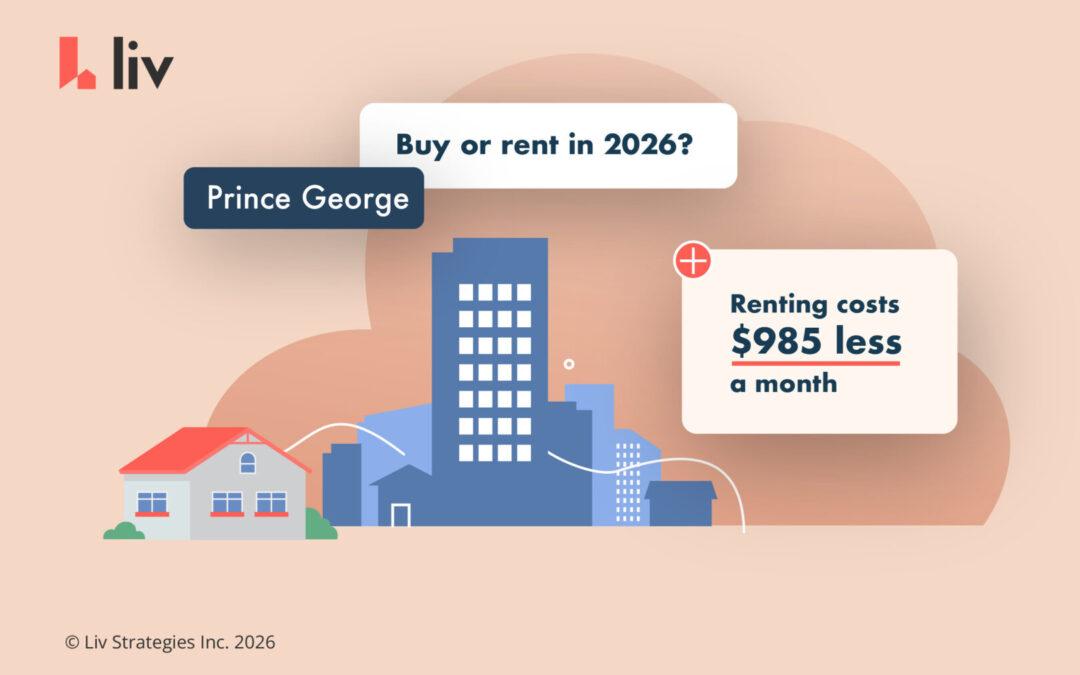
Renting costs you less than owning in month one in our calculation. Owning a condominium costs about $3,184 a month at the Victoria Core area condominium price of $547,800 (September 2026). That’s $1,560 more than the CMHC one-bedroom rent of $1,624 and $1,063 more than the two-bedroom rent of $2,121 (October 2025). The price covers the Victoria Core area, not the City of Victoria alone, while the rents cover the wider census metropolitan area.
Buying could catch up only against the two-bedroom rent, in the ninth year, and only if prices rise 2% a year. With flat prices, it doesn’t catch up within 25 years against either rent. On September 2026 prices, owning comes closest if you have a long horizon, a two-bedroom unit in mind, and room to carry a gap near $1,063 a month. This is an illustration under our assumptions, not a forecast or advice.
For the national view, see Canada’s 2026 price-to-rent ranking, and for where to look if you keep renting, read our guide to the top rental sites in Victoria.
What is the average rent in Victoria?
CMHC’s October 2025 Rental Market Survey puts Victoria’s average rent for occupied purpose-built units at $1,624 for a one-bedroom and $2,121 for a two-bedroom. Those are occupied units, so a lease you sign today may cost more. Statistics Canada’s second-quarter 2026 estimate of the average asking rent for a two-bedroom in the Victoria metro area is $2,640.
Where is rent lowest in Victoria?
In CMHC’s October 2025 survey, Esquimalt had the lowest averages of the areas in our table: $1,465 for a one-bedroom and $1,775 for a two-bedroom. The Fort St. Area came next, at $1,510 and $1,868. The highest in our table were in Langford/View Royal/Colwood/Sooke, at $1,874 and $2,374.
Is it cheaper to rent or buy in Victoria?
In our calculation, renting costs less in month one. Owning a condominium at the Victoria Real Estate Board’s September 2026 Victoria Core area price of $547,800 costs about $3,184 a month. Against CMHC’s October 2025 average rents of $1,624 for a one-bedroom and $2,121 for a two-bedroom, that’s $1,560 or $1,063 more.
How long does it take for buying to catch up with renting in Victoria?
In our calculation, owning doesn’t catch up with renting within 25 years if prices stay flat, against either rent. If prices rise 2% a year, it catches up in the ninth year against the two-bedroom rent, and not within 25 years against the one-bedroom rent. The 2% path is a what-if, not a forecast.
Do first-time buyers pay property transfer tax on a Victoria condo?
If you’re an eligible first-time home buyer, you get an $8,000 exemption when fair market value is over $500,000 and up to $835,000, according to the B.C. government’s exemption guidance (last updated December 3, 2025). At the Victoria Core area condominium price of $547,800, the $8,956 tax would fall to $956, and closing costs to $3,956.
What is the rental vacancy rate in Victoria?
CMHC’s 2025 Rental Market Report says the overall vacancy rate in the Victoria census metropolitan area rose to 3.3%, the highest level since 1999. CMHC’s October 2025 table shows 3.4% for one-bedrooms and 3.0% for two-bedrooms in purpose-built rental units, while Victoria condominium apartments had a vacancy rate of 0.3%.


0 Comments