


At a glance
- Ontario rents continue to decline across major markets compared to last year
- Rents across Ontario have declined compared to last year, with one-bedroom unfurnished units averaging $1,970, down 8.8%. The largest drops were recorded in markets such as Brampton (-10.8%) and Downtown Toronto (-10.2%).
- Rents across Ontario have declined compared to last year, with one-bedroom unfurnished units averaging $1,970, down 8.8%. The largest drops were recorded in markets such as Brampton (-10.8%) and Downtown Toronto (-10.2%).
- Core and suburban markets show diverging rental trends in 2026
- While Downtown Toronto recorded consistent declines across all unit types, with one-bedroom rents down -4.72% since January and -5.94% month over month, outer markets such as Etobicoke saw strong growth. One-bedroom rents in Etobicoke increased +6.98% since January and +7.51% month over month, highlighting shifting demand toward suburban areas.
- While Downtown Toronto recorded consistent declines across all unit types, with one-bedroom rents down -4.72% since January and -5.94% month over month, outer markets such as Etobicoke saw strong growth. One-bedroom rents in Etobicoke increased +6.98% since January and +7.51% month over month, highlighting shifting demand toward suburban areas.
- Larger rental units are experiencing the most volatility across Ontario
- Three-bedroom rents have shown the widest fluctuations, with Etobicoke rising +16.91% since the start of the year while other markets, such as Ottawa, declined -3.40% month over month. This uneven movement suggests demand for larger units remains inconsistent across regions.
- Three-bedroom rents have shown the widest fluctuations, with Etobicoke rising +16.91% since the start of the year while other markets, such as Ottawa, declined -3.40% month over month. This uneven movement suggests demand for larger units remains inconsistent across regions.
Download The Latest Toronto Rent Report
For the complete Toronto rent report, download here.
Download liv.rent’s 2026 Canada Rental Market Trends Report for in-depth insights and forecasts on average rent prices, regional market comparisons, key economic drivers, and emerging AI trends shaping Canada’s rental landscape.
As of April 29th, 2026, the Bank of Canada maintains the interest rate at 2.25%, holding steady for the fourth consecutive announcement. Experts predict this rate will be maintained through most of 2026.
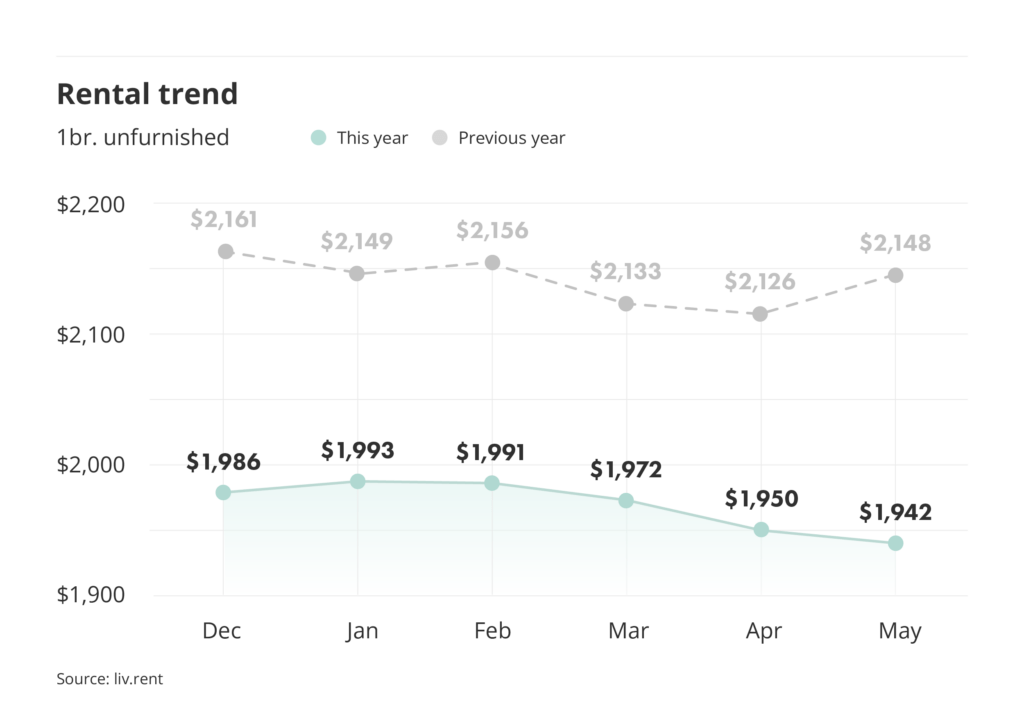
As of May 2026, the City of Toronto’s average monthly rent for an unfurnished one-bedroom dropped YoY by $206, reaching a new average of $1,942/month.
Ontario rent trends
Compared to last month, the average rent price for an unfurnished one-bedroom unit in Toronto decreased by $8 this May to $1,942/month. The average rent for a furnished one-bedroom increased by $15 since last month, bringing the rate to $1,998/month.
Planning on raising rent this year? Ontario’s Annual allowable rent increase limit for 2026 is 2.5%. Find out when and how you can increase rent and ensure you’re complying with provincial guidelines by reading our updated Guide to Ontario Rent Increases.
>> Recommended Reading: What is Ontario’s maximum allowable rent increase?
Is your rental priced competitively?
Find out with a free rent estimate. Our team of rental experts will calculate your unit’s true value based on your listing details & current market trends.
Month-to-month rent change
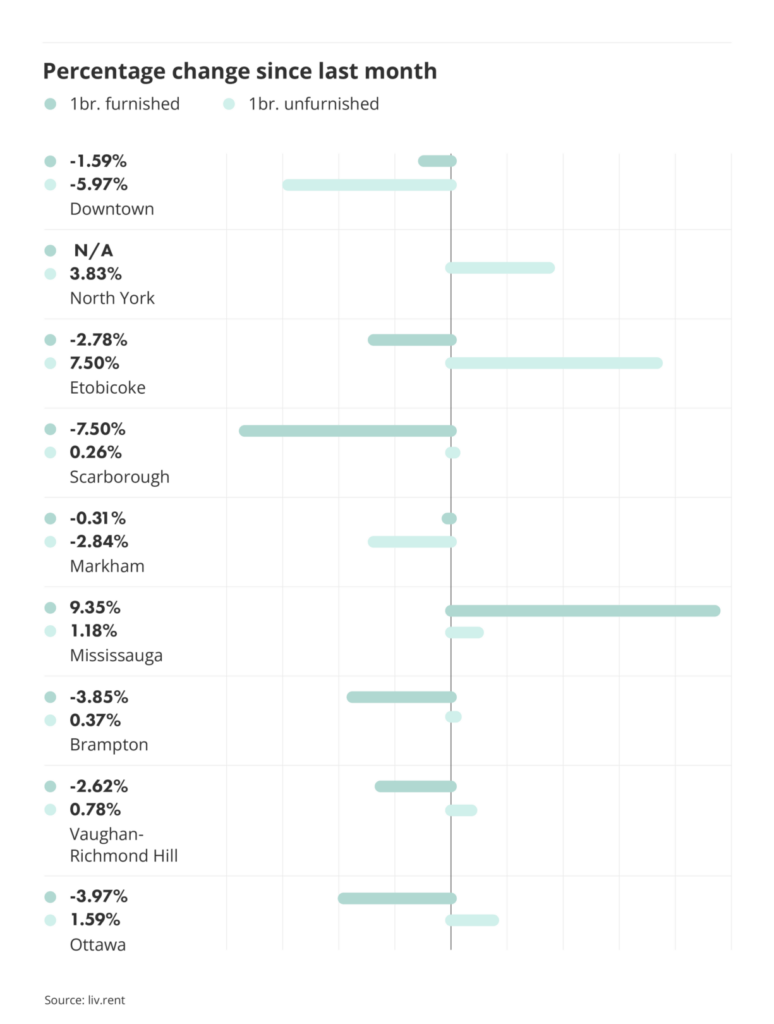
This chart breaks down the percentage change in rent prices across all GTA cities/municipalities between April and May 2026.
Unfurnished Toronto rent trends
For unfurnished one-bedroom units, Downtown (-5.97%) and Markham (-2.84%) saw the largest decreases, while Etobicoke (7.50%), North York (3.83%), and Ottawa (1.59%) saw notable increases.
Furnished Toronto rent trends
This month, average rent prices for furnished one-bedroom units across the GTA saw notable declines, with Scarborough recording the steepest drop at -7.50%. Mississauga was the only city to see an increase, rising by +9.35%.
Toronto furnished vs unfurnished averages
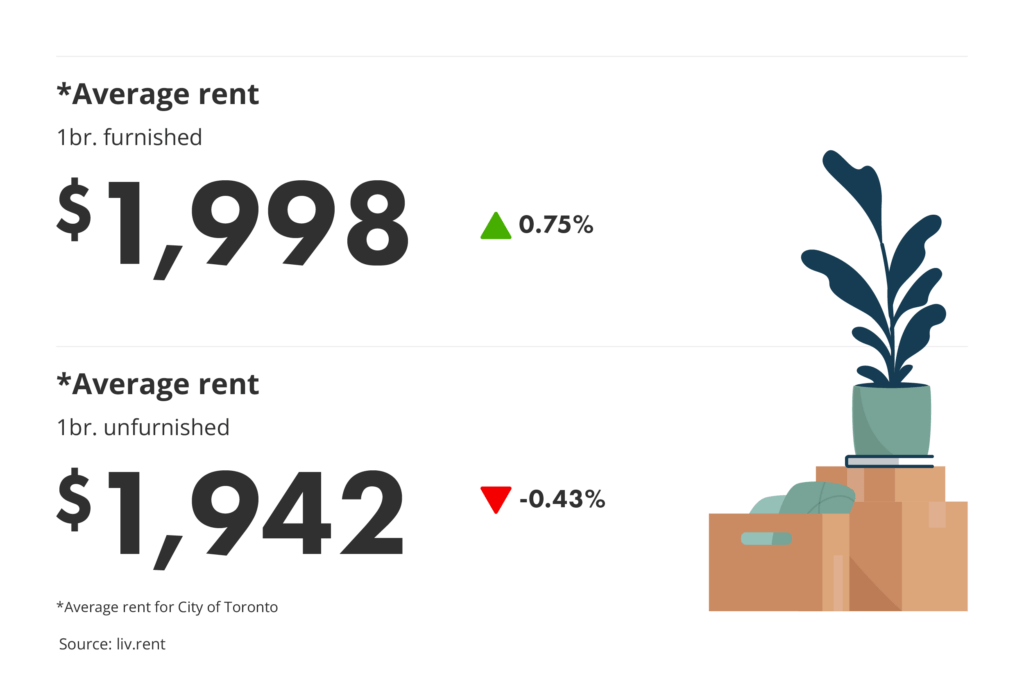
This month, prices for unfurnished one-bedroom units saw a decrease (-0.43%) to $1,942/month while furnished units increased (0.75%) to $1,998/month. The average furnished one-bedroom unit rents for $56 more than a one-bedroom unfurnished unit.
Rent per square foot
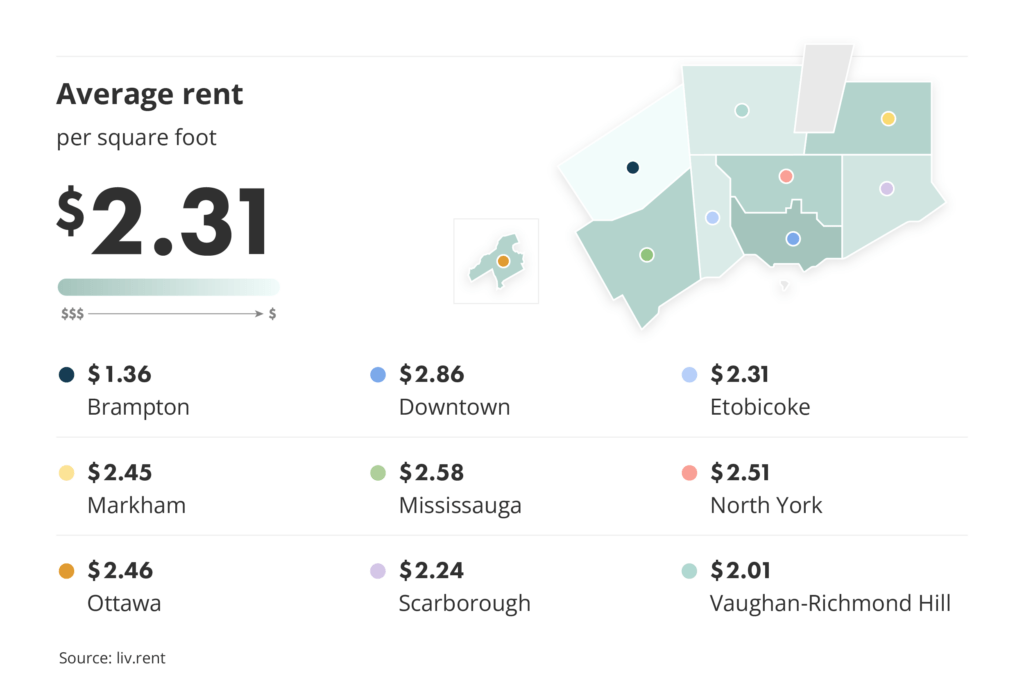
Our monthly Rent Reports also look more closely at the average rent per square foot in cities throughout the Greater Toronto Area. This May, Downtown ($2.86/sq. ft.) had the highest rent per square foot. At the other end of the spectrum, Brampton had the lowest rent per square foot ($1.36/sq. ft.).
Active listing data
We’ll also look at detailed statistics for currently active listings available to see which property types and number of bedrooms are the most represented. For renters, these numbers show which types of units you’re most likely to encounter in the Greater Toronto Area, while for landlords, you can assess how much competition you’ll face based on the current supply.
Active listings by property type
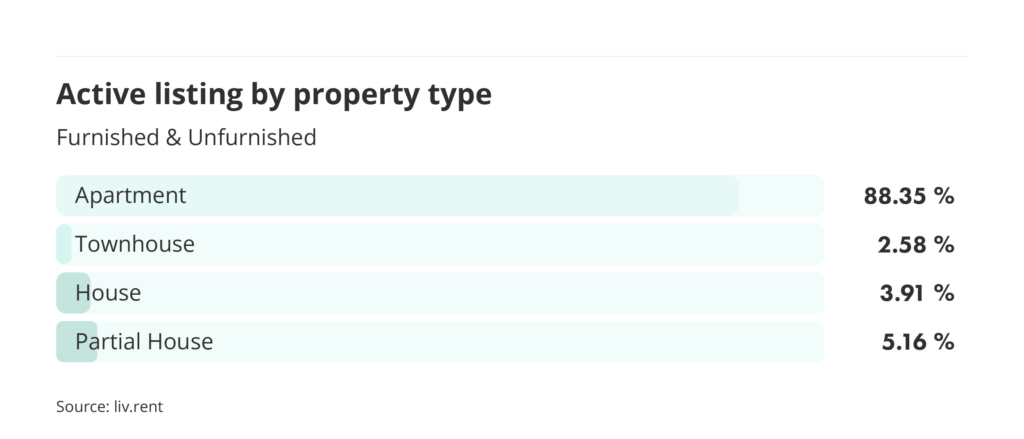
As of May 2026, the most common rental property type was apartments, dominating the majority of all listings in the GTA at 88.35%. Partial houses were the second most common unit type this month, representing 5.16% of active listings, followed by houses at 3.91% and townhouses at 2.58%.
Active listings by number of bedrooms
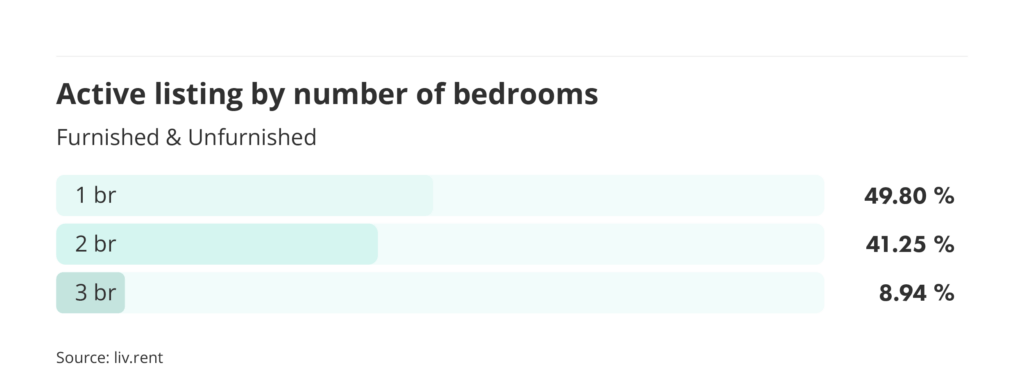
In terms of the number of bedrooms, we saw a varied spread across active listings on the market this May. One-bedroom units were the most common type of listing in the GTA this month at 49.80%, while two-bedroom units represented 41.25% of the region’s active listings. Three-bedroom units made up the remaining 8.94%.
City breakdown
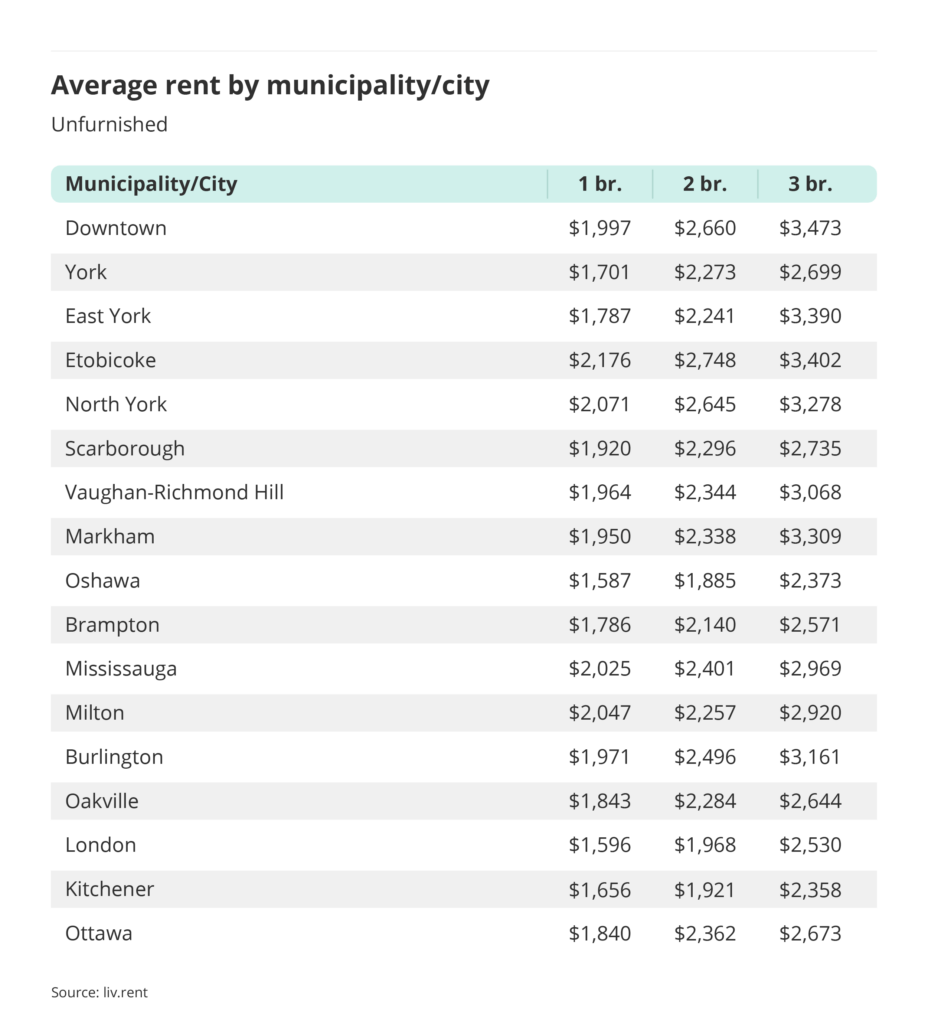
This May, Oshawa is the cheapest municipality to rent in out of the areas we look at for our Rent Reports, while Oakville is the region’s most expensive place to rent this month.
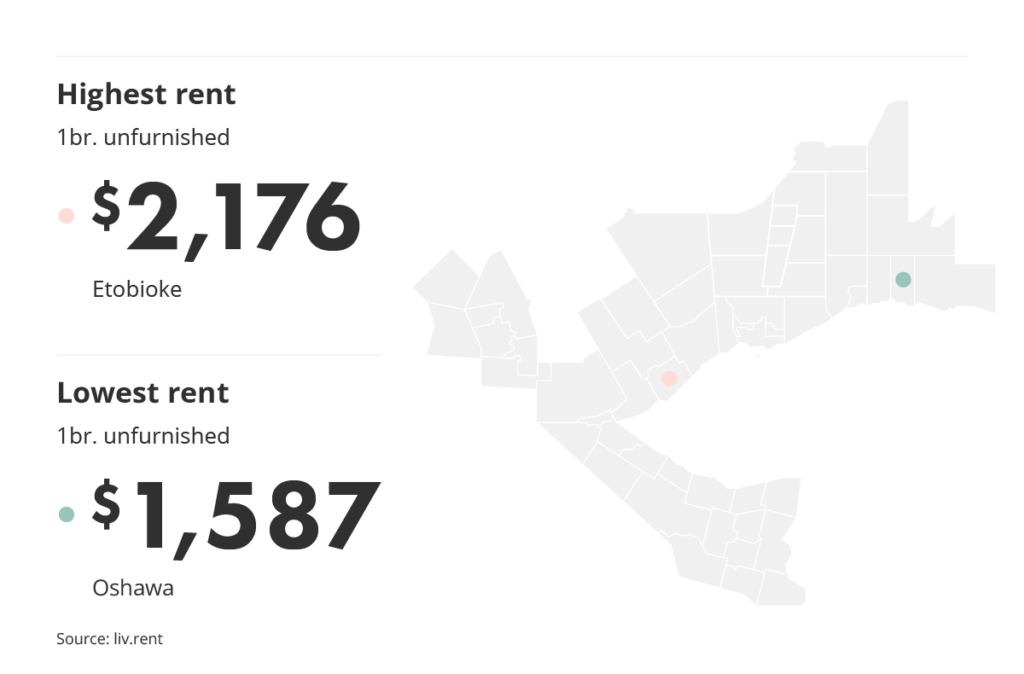
The average rent price for an unfurnished one-bedroom unit in Etobicoke currently stands at $2,176/month, while in Oshawa the same type of unit rents for an average of $1,587/month – a difference of $589 between the two.
Read More: Rental Vacancy Rates In The City Of Toronto
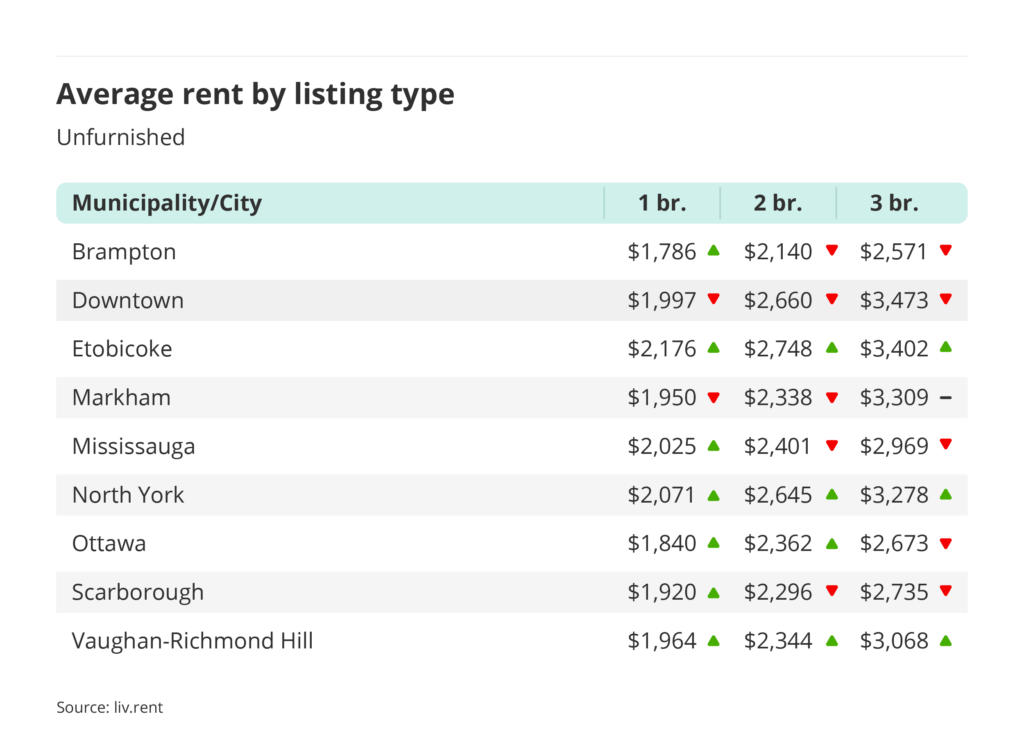
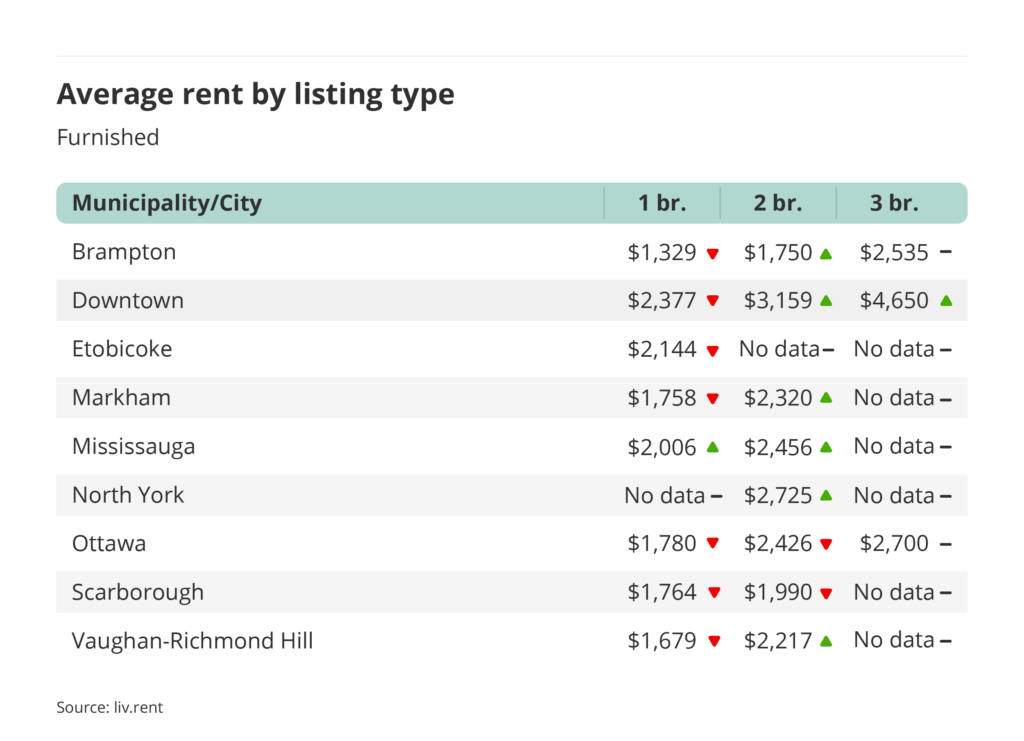
With Ontario’s different communities being so diverse, we’re breaking down the GTA into its different cities and municipalities to see the price difference within listing types: one-bedroom, two-bedroom, and three-bedroom units, both unfurnished and furnished.
- All prices for unfurnished one-bedrooms increased except in Markham and Downtown.
- All furnished one-bedroom units decreased except in Mississauga.
- Etobicoke, North York, and Vaughan-Richmond Hill were the only cities that saw an increase in price for all types of unfurnished units.
Rental averages for other Ontario cities
We’ve also looked at data from cities and municipalities in other regions within and surrounding the GTA. Looking at these additional cities, Oshawa is the least expensive to rent in May for one-bedroom unfurnished units at $1,587/month. Etobicoke is the most expensive for unfurnished one-bedroom units at $2,176/month.
For complete data on these cities as well as other municipalities outside of the Greater Toronto Area, download our full report here to view the complete report.
Is your rental priced competitively?
Find out with a free rent estimate. Our team of rental experts will calculate your unit’s true value based on your listing details & current market trends.
Most expensive cities in Canada
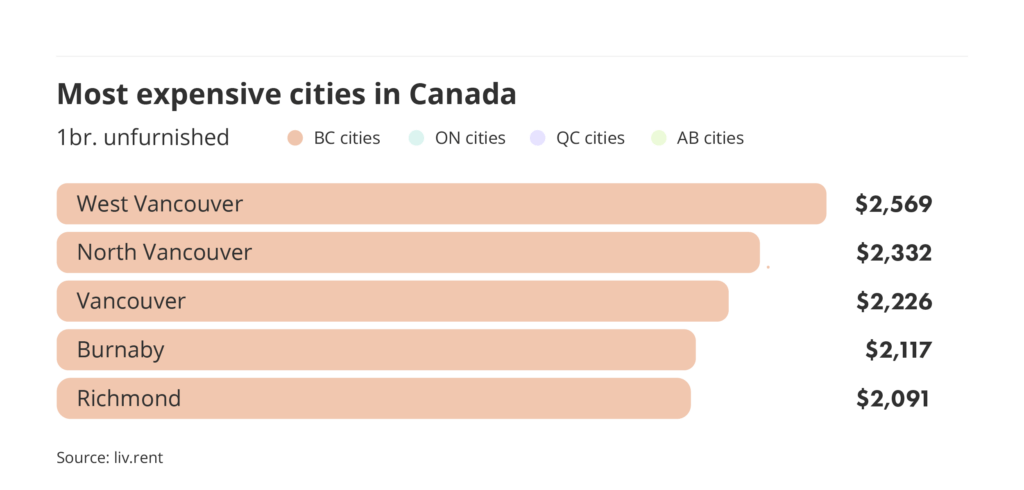
This May, all of the country’s most expensive cities are located in Metro Vancouver. West Vancouver is the most expensive city in the country to rent in, followed by North Vancouver, Vancouver, Burnaby and Richmond.
Downloadable resources
Our complete May 2026 Rent Report has information on even more key areas, broken down into region and unit type for a complete overview of rental averages in Ontario. To view these and all the other new information we’ve added, be sure to download your copy of the Rent Report below.
Download The Latest Toronto Rent Report
For the complete Toronto rent report, download here.
Renting in Ontario
For more information on renting in Ontario, refer to these comprehensive resource posts:
- What’s A Standard Rental Application?
- What do you need when applying for a rental?
- What Can A Landlord Ask For On A Rental Application In Ontario?
- How Do I Fill Out A Rental Application?
- Ontario Standard Lease Explained
- Frequently Asked Questions: Everything You Need to Know About Eviction in Ontario
Data collection methodology
Our monthly rent reports use data from our own liv.rent listings, as well as data our team manually collects from other popular listing sites – looking at available basement suites, apartments, condos, townhouses, semi-detached houses, and single-detached houses for each area.
When collecting this data, we do exclude luxury properties listed at over $5,000, as well as rooms for rent and shared accommodation. Investing in manual data collection means that we only consider the current month’s listing, since we can filter out duplicate listings and older ads that haven’t been removed.
Another key difference between our data collection methods and some government agencies like the CMHC is that we only include current asking rent prices. Many official reports will include data for entire buildings in their reports, which tends to skew numbers lower since many units are already occupied, and may be rent-controlled or rented for significantly lower than the current rates.
As we are a Canadian rental platform founded and based in Vancouver, we want to ensure that we’re providing a completely accurate depiction of the rental market in the cities we look at.

Rethink The Way You Rent
Not on liv.rent yet? Experience the ease of digital applications & contracts, verified tenants & landlords, virtual tours and more – all on one platform. Sign up for free or download the app.
Subscribe to receive monthly updates on Canada’s major rental markets. Discover last month’s Rent Reports below:
Vancouver Rent Report
Ontario Rent Report
Montreal Rent Report
Calgary and Edmonton Rent Report

0 Comments