


Doing taxes can be challenging enough, but add in the fact that you’re a non-resident or newcomer to Canada and it can quickly become even more complicated.
This guide is designed to help clear up some of the most common tax questions renters may have when preparing their Canadian tax returns. It’s especially helpful for non-residents or newcomers who may be filing taxes in Canada for the first time.
If you’re working or studying in Canada temporarily, understanding how the Canadian tax system works can help you file correctly and potentially maximize your tax return during the 2026 tax season (filing 2025 income).
In this guide, we’ll walk through the basics of Canada’s taxation system, how to file your taxes, and some general tips that may help you maximize your return. Of course, everyone’s tax situation is unique, and it’s ultimately your responsibility to ensure you comply with the rules. For the most accurate and up-to-date information, be sure to check the latest guidance from the Canada Revenue Agency (CRA).
When it comes to tax, you have to start with the basics. At our webinar we will be going over:
- An overview of the Canadian tax system
- Important tax dates for the 2026 tax season
- What happens if you miss the tax filing deadline
- How to determine your tax residency in Canada
Canada’s tax system
In Canada, we have a progressive tax system, which means the more income you earn, the higher the rate of tax you may pay on portions of that income.
In addition to federal income tax, Canadians also pay provincial or territorial tax, which varies depending on the province or territory where you live.
For the 2025 tax year (filed during the 2026 tax season), the federal basic personal amount can be up to $16,129, meaning individuals can earn up to this amount before paying federal income tax, depending on their income level.
Most people are required to file a tax return each year, even if they did not earn income. Filing ensures that you receive any refunds or benefits you may be eligible for, and failing to file could lead to penalties or missed credits.
In many cases, people — including non-residents and temporary residents — may have more tax deducted than necessary during the year, which can result in a tax refund when they file their return.
Overpayments can happen in several areas, including:
- Income tax
- Canada Pension Plan (CPP) contributions
- Employment Insurance (EI) contributions
What do you need to prepare your tax return?
Before you do your taxes, make sure that you have this information and all of these documents available:
- Social Insurance Number
- T4 document
- T4A
- T2202
- ID (Passport)
- Receipts
- Entry and exit dates
Important tax dates for 2023
Get out your calendar apps because there are several key dates to keep in mind during tax season.
The Canadian tax year follows the calendar year, running from January 1 to December 31. Tax returns are then filed at the beginning of the following year.
Most Canadians can typically begin filing their tax returns in mid-February, when the Canada Revenue Agency (CRA) opens NETFILE for the season.
Here are some important tax deadlines to note:
- Last day of February — Deadline for employers to issue T4 slips to employees
- April 30 — Deadline to file your tax return for most individuals
- April 30 — Deadline to pay any taxes owed to the CRA
- June 15 — Tax filing deadline for self-employed individuals (or those with a self-employed spouse or common-law partner)
What happens if I don’t file my tax return?
It pays to file your taxes. In Canada, most individuals are required to file a tax return each year, and failing to do so could affect certain government benefits or future immigration applications.
If you miss the tax filing deadline and owe money to the Canada Revenue Agency (CRA), you may be charged penalties and interest on the balance owing. The CRA typically applies a 5% late-filing penalty, plus an additional 1% of the balance owing for each month your return is late, up to a maximum of 12 months.
Understanding your tax residency status is also an important part of filing taxes in Canada, as it determines how your income is reported and taxed.
Canada’s income tax brackets are set by the Canada Revenue Agency (CRA) to determine how much federal income tax you pay each year. These brackets are adjusted periodically to reflect inflation and changes in the cost of living.
Here is a breakdown of the federal tax brackets for the 2025 tax year:
- 15% on the portion of taxable income that is $57,375 or less, plus
- 20.5% on the portion of taxable income over $57,375 up to $114,750, plus
- 26% on the portion of taxable income over $114,750 up to $177,882, plus
- 29% on the portion of taxable income over $177,882 up to $253,414, plus
- 33% on the portion of taxable income over $253,414
2. Tax hacks to get a bigger return
In our webinar, we’ll be looking at five key areas where you can help yourself get a bigger return:
- T2202 Tuition & enrolment certificate
- Expenses
- Medical expenses
- TD1 Form
- Tax Forms T4 & T4A
1. T2202 Tuition & enrolment certificate
The T2202 form is the official income tax receipt issued by qualifying educational institutions. It allows students to claim the tuition tax credit when filing their Canadian income tax return. These forms are typically available for download through your school’s online student portal.
To be eligible, you must have paid more than $100 in eligible tuition fees during the tax year. Students may be able to claim both federal and provincial tuition tax credits, depending on the province where they reside.
The federal tuition tax credit is calculated by multiplying your eligible tuition amount by the federal tax credit rate of 15%.
If you cannot use the entire credit in the current year, you may be able to carry forward the unused amount to future tax years or transfer a portion to a parent, spouse, or common-law partner (subject to CRA limits).
You can check any unused tuition amounts by logging into your CRA My Account, selecting Tax Returns, and viewing your Carryforward amounts.
2. Expenses
If you earned income during the year, you may be able to claim certain deductions and tax credits to reduce your overall tax liability.
Examples of eligible expenses and credits include:
- Medical expenses, such as doctor visits, prescriptions, and certain medical procedures
- Tuition fees (reported on the T2202 form)
- Charitable donations
- Union or professional dues
- Work-from-home expenses, such as eligible supplies and employment-related costs (if you qualify and your employer provides the required form)
If you plan to claim any of these expenses, it’s important to keep proper documentation and receipts to support your claims in case the Canada Revenue Agency (CRA) requests verification.
3. Medical expenses
You can also claim eligible medical expenses that you paid for yourself, your spouse, or your common-law partner.
Examples of eligible medical expenses include:
- Prescribed medications
- Health insurance premiums and certain therapies
- Dental care
- Medical devices, such as baby breathing monitors
- Mobility aids, including crutches
- Corrective lenses or glasses
- Service animals
When claiming medical expenses, only the portion that exceeds 3% of your net income (or $2,759, whichever is less) can be used to calculate the tax credit.
The federal medical expense tax credit is calculated at 15% of the eligible amount remaining after this threshold.
You may also need to understand common tax forms such as the TD1, T4, and T4A, which help determine how much tax is withheld and reported for your income.
4. BC Renter’s Tax Credit
The B.C. Renter’s Tax Credit provides up to $400 per year to eligible individuals and families who rent their homes in British Columbia.
To qualify, you must have rented an eligible rental unit in B.C. for at least six months during the tax year and meet the income requirements.
Individuals and families with an adjusted income under $63,000 may qualify for the full $400 credit, while those with incomes between $63,000 and $83,000 may receive a reduced amount.
This credit can help lower the overall amount of provincial tax you owe when filing your tax return.
3. What’s new for the 2023 tax filing season
In the final section of this guide, we break down some important tax updates and considerations that landlords should be aware of for the 2025 tax year.
1. Deadline for filing
For the 2025 tax year, the deadline to file your tax return and pay any amount owing is April 30, 2026.
2. Home office expenses
Home office expenses
Home office expenses may be available to employees who were required to work from home as part of their employment and paid eligible expenses related to their workspace.
For the 2025 tax year, employees can claim work-from-home expenses using the Detailed Method. This method requires calculating the portion of eligible expenses related to your workspace, such as utilities, internet, and certain office supplies.
To claim these expenses, your employer must provide a T2200 or T2200S form confirming that you were required to work from home and were responsible for covering these costs.
Be sure to keep all receipts and documentation, as the Canada Revenue Agency (CRA) may request proof of your expenses.
Detailed process
This deduction can cover certain work-from-home expenses, such as office supplies, utilities, and other eligible costs related to maintaining a workspace at home.
However, you must have employer authorization to claim these expenses. Your employer will need to complete and sign Form T2200 (Declaration of Conditions of Employment) or Form T2200S confirming that you were required to work from home and were responsible for these costs.
About TurboTax Canada

TurboTax® is Canada’s #1 tax preparation software to file taxes online. No matter your tax situation, TurboTax® has you covered. Prepare and file your taxes online securely with 100% accuracy.
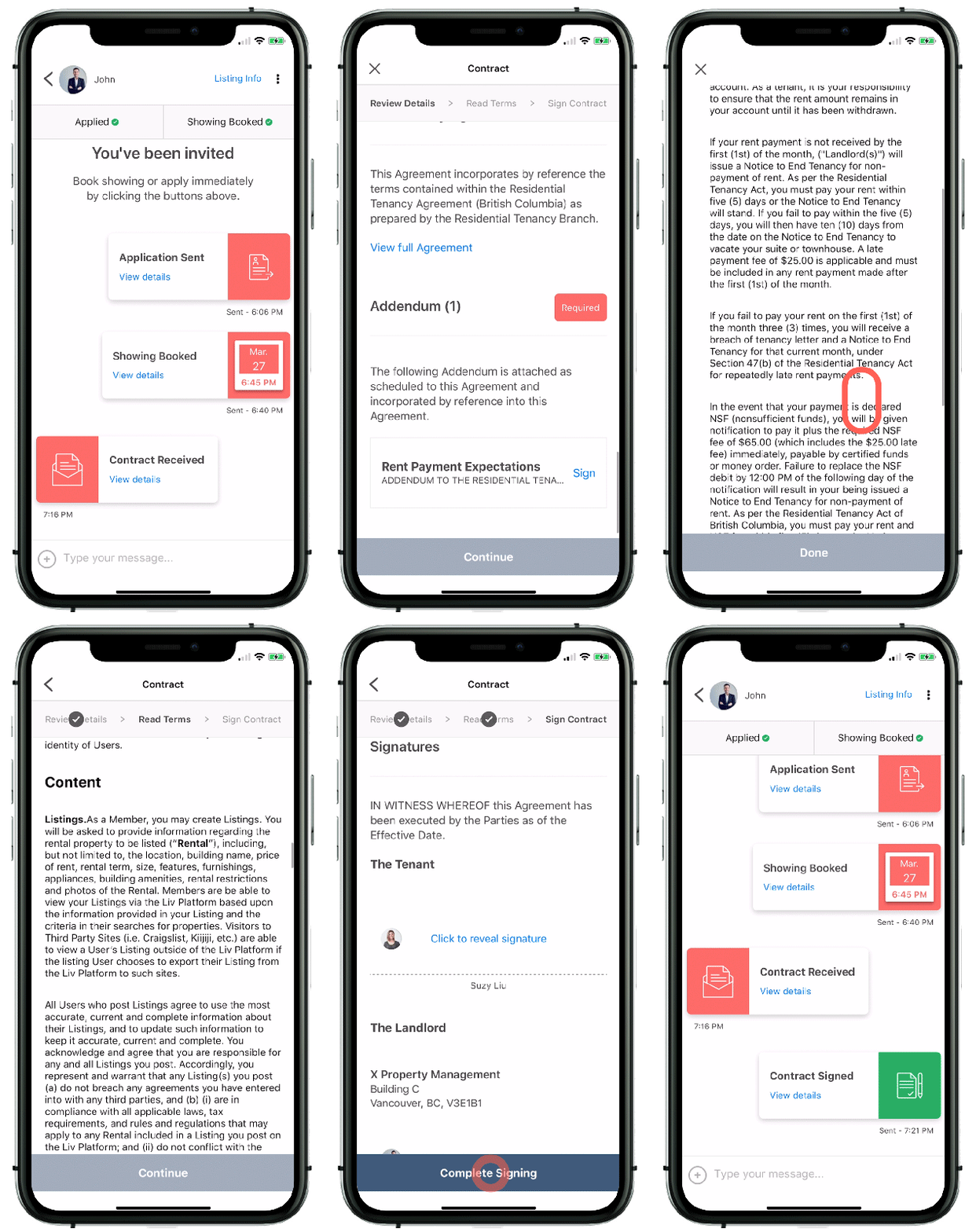
Rethink The Way You Rent
Not on liv.rent yet? Experience the ease of digital applications & contracts, verified tenants & landlords, virtual tours and more – all on one platform. Sign up for free or download the app.
Subscribe to receive the latest tenant & landlord tips and get notified about changes in the Canadian rental market.
>> Stay up-to-date on the average rent in Vancouver, Toronto and Montreal: Rent Reports.




0 Comments