


The Manitoba Residential Tenancies Branch (RTB) is the provincial office that answers landlord and tenant questions, mediates disputes, and holds hearings under The Residential Tenancies Act. You can reach its Winnipeg office at 204-945-2476, or toll-free in Manitoba at 1-800-782-8403, Monday to Friday from 8:30 a.m. to 4:30 p.m. Below you’ll find every office and online option, then common situations, with the steps and the rules for 2026 and 2027.
Originally published 2025, updated November 2026.
Join Our Newsletter
For more info on rental laws and policies (e.g. eviction, lease agreements, repairs & maintenance), subscribe to get the latest news.
How to contact the Manitoba Residential Tenancies Branch
The RTB has three offices, and you can call, email, write, or walk in at any of them. Each one is open from 8:30 a.m. to 4:30 p.m., Monday to Friday, except statutory holidays. The details below come from the RTB’s contact page, checked on November 17, 2026.
| Office | Address | Phone | Toll-free in Manitoba | |
| Winnipeg (main office) | 1700-155 Carlton Street, Winnipeg, MB R3C 3H8 | 204-945-2476 | 1-800-782-8403 | rtb@gov.mb.ca |
| Brandon | 143-340 9th Street, Brandon, MB R7A 6C2 | 204-726-6230 | 1-800-656-8481 | rtbbrandon@gov.mb.ca |
| Thompson | 113-59 Elizabeth Drive, Thompson, MB R8N 1X4 | 204-677-6496 | 1-800-229-0639 | rtbthompson@gov.mb.ca |
Offices sometimes close for a day or more, so check the notice at the top of the RTB home page before you make the trip. If you’re dropping off paperwork in person, the branch processes at most two documents per person per day while you wait. Anything more is processed in order and returned to you later.
What you can do online
Most of the RTB’s work still happens by phone, by mail, or at the counter. A few things don’t need a visit, though:
- Fact sheets and forms, including tenancy agreements, condition reports, notices, and claim forms, in fill-and-print format.
- The Notice of Rent Increase form, which landlords can send as an electronic form submission.
- A security deposit interest calculator, and a page for tenants to check for unclaimed money the RTB holds in trust for them.
- Hearing evidence, which you can email to rtbevidence@gov.mb.ca at least two full business days before your hearing.
- The Residential Tenancies Orders System, a searchable database of RTB orders that costs $250 a year by subscription (as of November 2026).
If you disagree with an RTB decision, the appeal goes to a separate body, the Residential Tenancies Commission. It’s at 1650-155 Carlton Street in Winnipeg, 204-945-2028, or rtc@gov.mb.ca, according to the RTB’s own guidebook.
What the Residential Tenancies Branch does
Under RTB policy, the branch has exclusive jurisdiction over disputes between Manitoba landlords and tenants, from deposits to repairs to evictions. Its fact sheet on the branch lists four jobs:
- Information: it explains your rights and responsibilities by phone, in person, or by letter, and runs seminars.
- Investigation: officers look into possible breaches of the Act, contacting the landlord, the tenant, witnesses, and agencies such as public health inspectors.
- Mediation: staff try to settle most disputes, such as deposit claims and notices to move, and a mediated agreement is put in writing and can be enforced.
- Adjudication: a hearing officer decides claims and applications and issues a written order with reasons.
There are limits. The branch’s policy guidebook says it can’t award compensation for personal injury, pain and suffering, wages lost while attending a hearing, or legal fees.
Common situations and the steps to take
Find your situation below for the steps. The rules behind each step are in the sections that follow.
You have received a rent increase notice
- Check the date. You must get written notice at least three months before the increase takes effect.
- Check that it’s been at least 12 months since your last increase.
- Check the amount against the guideline: 1.8% for increases taking effect in 2026, and 3.0% for 2027.
- If it’s higher than the guideline, find out whether your unit is exempt or whether your landlord has applied to the RTB for an above-guideline increase.
- Still unsure? The RTB answers rent increase questions at the numbers above.
You want your deposit back, or you want to claim against it
- Tenants: make sure the landlord has your new address, since the Act has separate rules for when a tenant can’t be located.
- Landlords with no claim: return the deposit plus interest within 14 days after the tenancy ends.
- Landlords with a claim: send the tenant written notice of the amount within 28 days and return any part you aren’t claiming.
- If you can’t agree in writing, either of you can ask the RTB to decide.
Repairs are not getting done
- Ask the landlord in writing, and keep a copy.
- Don’t hold back rent. The RTB says tenants shouldn’t.
- Send the details to the RTB, with a copy to the landlord. The branch can contact the landlord, inspect, and order the repairs.
- If the delay has cost you, you can file a claim for compensation.
You need a decision on money or possession
- File the RTB’s Claim and Notice of Hearing form or an Application for an Order of Possession at any office, or by mail, with the filing fee ($50 or $60 as of November 2026).
- Give the other side the claim and hearing notice at least five days before the hearing.
- Send your evidence to the RTB and the other side at least two full business days before the hearing.
- Attend, send a representative or a written response, or ask to join by teleconference where reasonable.
- If you disagree with the order, appeal to the Residential Tenancies Commission on time.
Manitoba rent increase guideline for 2027
Manitoba’s rent increase guideline is 3.0% for increases that take effect from January 1, 2027, up from 1.8% in 2026. The RTB’s guideline page confirms the figure, and the province announced it on September 3, 2026. On rent of $1,000 a month, that’s a raise of up to $30 a month in 2027, or $360 over the year. Our guide to rent increase rules in Manitoba covers the notice form and how to object in more detail.
The figure isn’t picked at random. The RTB’s calculation compares the average Manitoba Consumer Price Index for the 12 months ending June 30, 2026 (167.4) with the 12 months before (162.3). That works out to just over 3%, but the guideline has to stay within the Bank of Canada’s one to three per cent target range, so it’s set at the top of the range.
| Year the increase takes effect | Manitoba rent increase guideline |
| 2027 | 3.0% |
| 2026 | 1.8% |
| 2025 | 1.7% |
| 2024 | 3.0% |
| 2023 | 0% (freeze) |
| 2022 | 0% (freeze) |
| 2021 | 1.6% |
Source: the RTB’s rates fact sheet, checked November 17, 2026.
Notice and timing rules
Your landlord has to give you written notice at least three months before an increase starts. For a January 1, 2027 increase, that meant notice on or before September 30, 2026. In most cases, rent can only go up once a year, and the RTB provides the Notice of Rent Increase form landlords use.
Which units the guideline does not cover
The guideline applies to most apartments, single rooms, houses, and duplexes. These units are exempt, according to the RTB’s 2027 guideline page:
- units renting for $2,000 or more a month (the threshold was $1,670 in 2026)
- various types of social housing
- units owned and operated by, or for, a provincial, municipal, or federal government
- units in buildings first occupied after March 2005, which the province says are exempt for 20 years
- not-for-profit life lease units and co-operative units
- approved rehabilitated rental units
The higher threshold matters. The province calls the move to $2,000 on January 1, 2027 the largest expansion of rent control in decades, and says it’ll mean lower costs for thousands of families. Exempt units still need three months’ written notice before any increase.
Increases above the guideline
A landlord can apply to the RTB for a bigger increase if the guideline won’t cover their cost increases. Since the province’s policy change on October 20, 2026, you don’t have to pay any part of a proposed above-guideline increase until the RTB has issued an order. If you’re on a fixed-term lease and your landlord applies for one, the RTB’s notice fact sheet for tenants says you can end the lease early with two full rental payment periods’ notice.
Security deposits and pet deposits in Manitoba
A Manitoba landlord can ask for a security deposit of up to half of the first month’s rent. On $1,400 a month, that’s $700 at most under the rules as of November 2026. Section 29 of The Residential Tenancies Act also says the landlord has to tell you a deposit is required before you sign. They can’t collect it until the agreement is made, and they must give you a written receipt.
If the landlord lets you keep a pet, they can also ask for a pet damage deposit of up to one month’s rent (for deposits collected from August 1, 2014). There’s only one pet deposit per tenancy, however many pets you have, and none for a service animal. Both deposits earn interest, and the RTB’s deposits fact sheet says it goes back to you with the deposit. The rate set for 2026 is 0.5% a year.
When you move out, the clock starts. A landlord with no claim must return the deposit and interest within 14 days. A landlord who wants to keep some of it has 28 days to send you written notice of the amount, and either of you can then ask the RTB to decide. A landlord’s claim for the deposit amount or less has no RTB filing fee.
Notice periods to end a tenancy in Manitoba
How much notice you need depends on who’s ending the tenancy, and why. The table sums up the RTB’s fact sheets and policy guide as of November 2026. Notice periods are counted in rental payment periods, which usually means a month.
| Situation | Notice required |
| Tenant on a month-to-month tenancy moves out | One full rental payment period (rent due on the first of the month: notice by June 30 to move July 31) |
| Tenant on a fixed-term lease | Responsible for rent to the end of the term, with some exceptions (below) |
| Tenant ends a fixed term early: personal care home, health, or domestic or sexual violence or stalking | One full rental payment period, with any certificate the RTB requires |
| Tenant ends a fixed term after an above-guideline increase application | Two full rental payment periods |
| Tenant’s health or safety is at risk because the landlord didn’t fix a breach after written notice | Five days |
| Landlord ends a tenancy after a written warning about a breach the tenant didn’t fix | At least one rental payment period |
| Landlord or family moving in, demolition, major renovation, or change of use | Three, four, or five months, depending on the local vacancy rate |
| Landlord ends a mobile home site tenancy for these reasons | At least six months |
A few more rules are worth knowing. On a fixed-term lease, your landlord must give you a renewal at least three months before it ends. If you want to stay, sign and return it at least two months before the end. Tenants with school-age children get extra time when the landlord gives notice to move in, renovate, demolish, or change the unit’s use. They can generally stay until the end of the school year, as long as the children go to a school that’s easy to reach from the unit. And when rent is more than three days late, the RTB says a landlord can give notice to move for non-payment.
When your landlord can enter your unit
Your landlord can’t just let themselves in. Section 54 of the Act says entry is allowed in an emergency, with your consent, or with a written notice that gives the reason and a reasonable time. That notice must arrive at least 24 hours, and no more than two weeks, before the entry.
If the time doesn’t work for you, you can object and offer a reasonable alternative. You don’t have to be home for a properly noticed entry. The Act was also amended on October 29, 2026. It now spells out that showing your unit to a prospective tenant, after notice to end the tenancy, needs the same written notice of at least 24 hours.
Repairs and emergency repairs
In Manitoba, your landlord has to keep the rental unit in good repair and meet health, building, maintenance, and occupancy standards. You’re responsible for damage you cause, or that someone you let in causes. The RTB’s repairs fact sheet sets out how it steps in when a landlord won’t act.
The branch may inspect and give the landlord a reasonable time to do the work. If it still isn’t done, it can order the repairs by a set date and, in the end, hire a contractor, with the tenant paying rent to the branch to cover it. Only send rent to the RTB when it asks you to. You can also claim compensation for an unreasonable delay, such as losing the use of an appliance or paying a higher water bill because of a running toilet.
For emergencies, the RTB’s Before You Rent fact sheet for tenants suggests asking your landlord who else you can contact in an emergency. If the landlord doesn’t fix a problem that puts your health or safety at risk within a reasonable time of your written request, the Act lets you give five days’ notice to move.
How disputes are decided at the RTB
The RTB tries mediation first for most disputes. When that doesn’t settle it, a hearing officer decides. Hearings are held in Winnipeg, Brandon, Thompson, and other judicial centres. They’re informal: no one is sworn in, and the officer weighs whose evidence is more believable.
The fees, as of November 2026, are $50 for a landlord or tenant claim for compensation and $60 for an Application for an Order of Possession. A tenant has seven days to appeal an Order of Possession to the Residential Tenancies Commission, and 14 days to appeal an order to pay compensation. If the other side doesn’t pay what an order says, you can file and enforce it in the Court of King’s Bench.
What changed in Manitoba rental law in 2025 and 2026
The earlier version of this guide covered Bill 212, a private member’s bill introduced in March 2025 to limit above-guideline increases. The Legislature’s list of bills for that session, which ended November 17, 2025, shows no enactment for it. These are the changes that did happen:
- Higher rent control threshold: units renting for under $2,000 a month come under the guideline from January 1, 2027, up from $1,670.
- No payment before an order: since October 20, 2026, tenants don’t pay a proposed above-guideline increase until the RTB rules on it. The province also announced regulation changes that it says cut the capital costs landlords can pass on through those increases by 40%.
- Bill 13, The Residential Tenancies Amendment Act: it received royal assent on October 29, 2026. Among other things, it adds 24 hours’ notice before showings and will require landlords to file information about each rental unit with the RTB, from a date still to be set.
Rules like these change, so check the news on the RTB home page before you act on a specific date. This guide is general information, not legal advice.
Renting in Manitoba with liv.rent
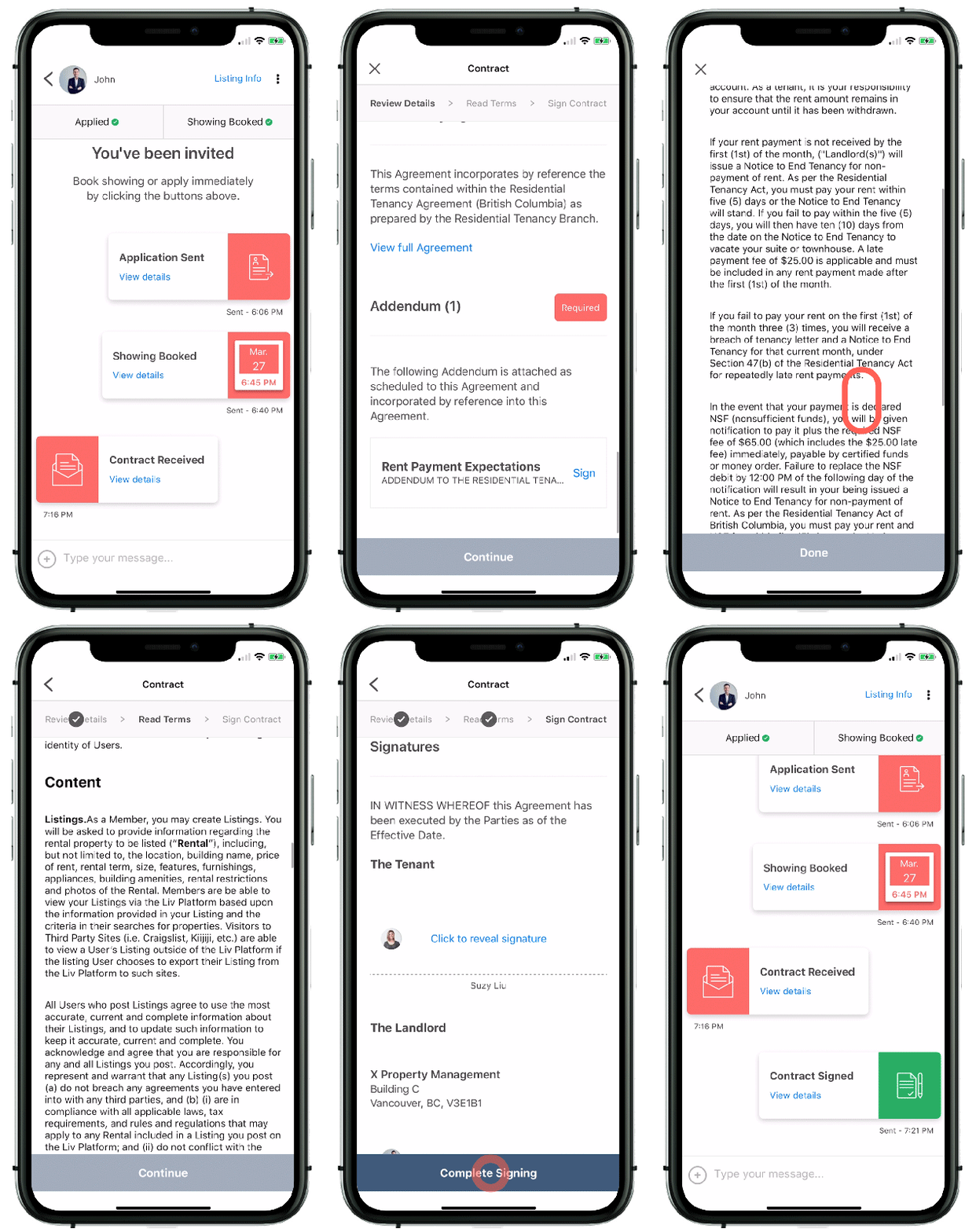
If you’re a landlord, liv.rent lets you take applications, sign tenancy agreements digitally, and keep your documents in one place, so you’ve got a paper trail if you ever need the RTB. If you’re a renter, you can browse apartments for rent in Manitoba and see how prices are moving in our Winnipeg rent reports.
FAQ: Manitoba Residential Tenancies Branch
How do I contact the Manitoba Residential Tenancies Branch?
Call the Winnipeg office at 204-945-2476, or toll-free in Manitoba at 1-800-782-8403, or email rtb@gov.mb.ca. There are also offices in Brandon (204-726-6230) and Thompson (204-677-6496). All three are open Monday to Friday, 8:30 a.m. to 4:30 p.m., except statutory holidays, according to the RTB in November 2026.
What is the Manitoba rent increase guideline for 2027?
It’s 3.0% for increases that take effect from January 1, 2027, up from 1.8% in 2026, according to Manitoba’s Residential Tenancies Branch. On $1,000 a month, that’s up to $30 more a month. Units renting for $2,000 or more, buildings first occupied after March 2005, and some social housing are exempt.
How much can a landlord charge for a security deposit in Manitoba?
Up to half of the first month’s rent, under section 29 of The Residential Tenancies Act. A landlord who allows a pet can also ask for one pet damage deposit of up to one month’s rent, but none for a service animal. The deposit earns interest, set at 0.5% a year for 2026.
How long does a Manitoba landlord have to return a deposit?
If the landlord has no claim, they must return the deposit and interest within 14 days after the tenancy ends. If they want to keep some of it, they have 28 days to send the tenant written notice of the amount. If the two sides can’t agree, either one can ask the Residential Tenancies Branch to decide.
How much notice does a tenant have to give to move out in Manitoba?
On a month-to-month tenancy, a tenant must give one full rental payment period’s notice. If rent is due on the first of the month and you want to leave July 31, the landlord must get your notice by June 30. On a fixed-term lease, you’re usually responsible for rent until the term ends, with some exceptions.
Can a landlord in Manitoba enter without notice?
Only in an emergency or with the tenant’s consent. Otherwise, section 54 of The Residential Tenancies Act requires written notice, given at least 24 hours and no more than two weeks ahead, stating the reason and a reasonable time. A tenant can object and suggest a reasonable alternative time instead.
How do I file a claim with the Residential Tenancies Branch?
Fill in the RTB’s Claim and Notice of Hearing form and file it at any office or by mail, with the $50 fee (as of November 2026). The branch sets a hearing date, and you must give the other side the claim at least five days before it. Send your evidence at least two business days ahead.
Rethink The Way You Rent
Not on liv.rent yet? Experience the ease of digital applications & contracts, verified tenants & landlords, virtual tours and more – all on one platform. Sign up for free or download the app.
Subscribe to receive the latest tenant & landlord tips and get notified about changes in the Canadian rental market.
>> Stay up-to-date on the average rent in Vancouver, Toronto and Montreal: Rent Reports.



0 Comments