


Starting May 27, 2025, first-time home buyers in Canada can receive up to $50,000 in GST relief on new homes priced up to $1 million, with partial rebates up to $1.5 million, a move that has been praised for helping open housing opportunities to young people. To qualify, buyers must be Canadian citizens or permanent residents, at least 18, using the home as a primary residence, and haven’t owned a home in the past four years. This rebate applies to purchases made by the end of 2030, with construction starting before 2031. Provincial rebates vary, and each Canadian province offers different incentives for different buyers. Getting familiar with your provincial benefits and keeping an eye on the most active rental and homeowner trends will ensure support and assurance in your housing journey.
Overview to First-Time Home Buyers Programs by the Government of Canada
The First-Time Home Buyer (FTHB) GST Rebate helps eligible Canadians save on newly built homes. You may qualify if you buy a new home from a builder, build one on your land, or purchase shares in a housing co-op. To be eligible, you must be at least 18, a Canadian citizen or permanent resident, and not have owned (or lived in a partner-owned) home in Canada or abroad in the current or past four calendar years. The rebate offers a 100% GST refund on new homes valued up to $1 million. For homes priced between $1 million and $1.5 million, the rebate phases out gradually—for example, a $1.25 million home would get a 50% rebate (up to $25,000). Homes over $1.5 million don’t qualify. The FTHB GST Rebate uses criteria similar to the existing GST/HST New Housing Rebate but is tailored specifically to benefit first-time buyers.
Who Qualifies as a First-Time Home Buyer in Canada?
In Canada, you qualify as a first-time home buyer if you meet all of the following conditions:
- You are a Canadian citizen or permanent resident
- You are at least 18 years old
- You have not owned and lived in a home in Canada or abroad in the current calendar year or in any of the four preceding calendar years
- Your spouse or common-law partner hasn’t owned and lived in a home during that same time period (if applicable)
This definition applies to most federal programs, including the First-Time Home Buyers’ Tax Credit (HBTC), the Home Buyers’ Plan (HBP), the First Home Savings Account (FHSA), and the new FTHB GST Rebate. Note: Some provincial or municipal programs may define “first-time buyer” differently, so it’s worth checking local rules for any added benefits or eligibility criteria.
Federal Mortgage & Savings Tools
First Home Savings Account (FHSA):
The First Home Savings Account (FHSA) is a tax-advantaged savings plan created to help first-time homebuyers in Canada. You can contribute up to $8,000 per year, with a lifetime limit of $40,000. Contributions are tax-deductible, and withdrawals are tax-free when used to buy a qualifying home. To open an FHSA, you must be a Canadian resident, at least 18, and not have owned a home in the last four years. If unused, funds can be transferred to an RRSP or RRIF without penalties. The FHSA blends features of both RRSPs and TFSAs, making it a powerful homeownership tool.
RRSP Home Buyers’ Plan (HBP):
The Home Buyers’ Plan (HBP) is a Canadian program that lets individuals withdraw up to $35,000 from their Registered Retirement Savings Plans (RRSPs) to buy or build a qualifying home, without immediate tax penalties. The funds act as an interest-free loan that must be repaid over 15 years. Couples can each withdraw $35,000, combining for a total of $70,000 toward the same home. The HBP can also be used to buy or build a home for a related person with a disability, making it a flexible option for supporting accessible homeownership needs.
30-Year Mortgage Amortization (New 2024 Rule):
Since December 15, 2024, the Canadian government allows 30-year amortization periods for insured mortgages on newly built homes purchased by first-time homebuyers. Previously, the maximum was 25 years for insured loans. This change is designed to lower monthly mortgage payments, helping more Canadians qualify for a mortgage and easing the financial burden of homeownership. While this extends the repayment timeline, it improves housing affordability by reducing upfront monthly costs, especially important in high-priced markets. The policy applies only to new construction homes and does not affect resale properties.
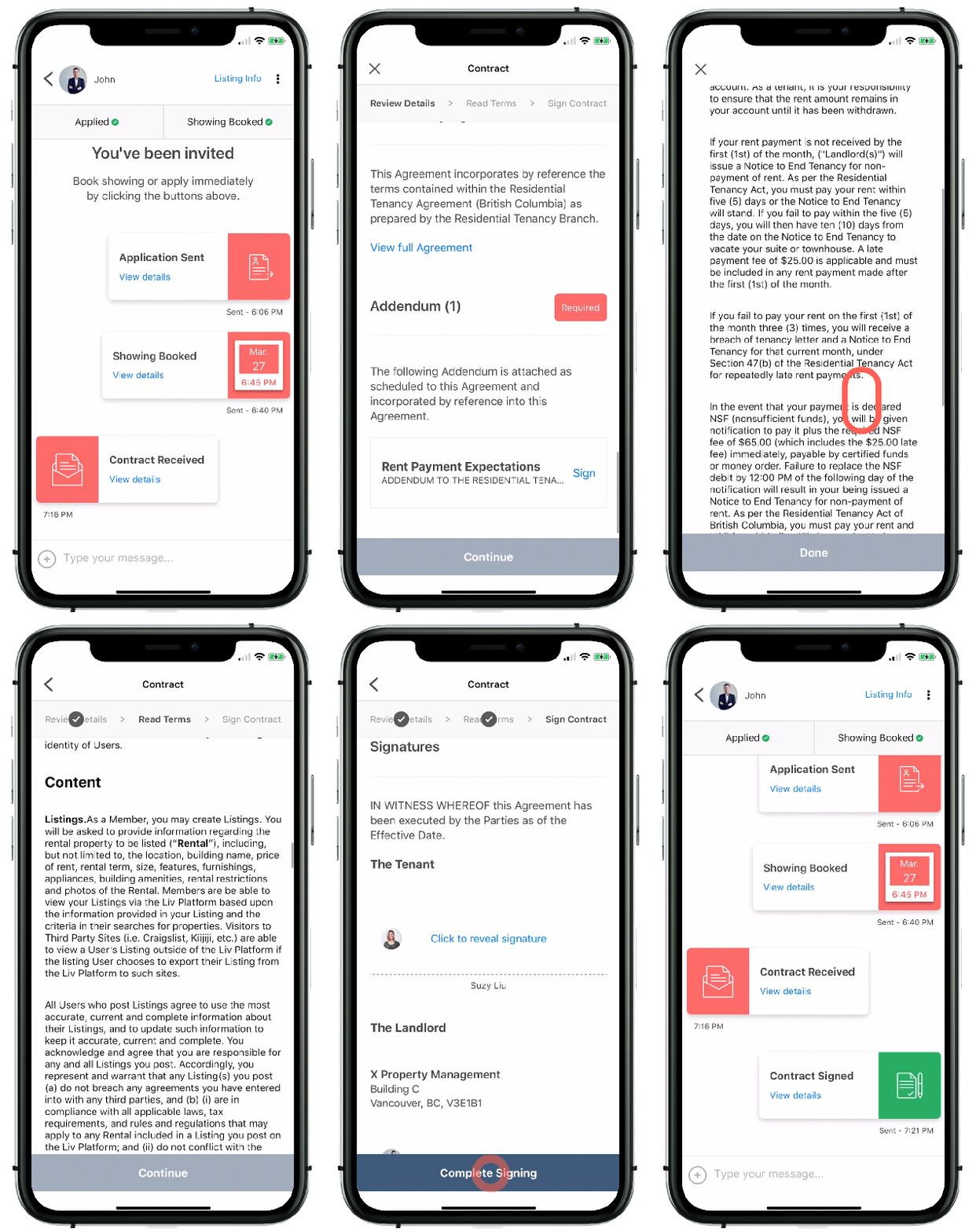
Maximize your liv.rent Experience
Canada’s safest rental platform liv.rent has introduced new updates aimed at enhancing the platform experience. Read this blog on liv.rent’s newest features including Persona, and updated listing categories to better describe, market and filter unit types.
BC Spotlight – Provincial Incentives for First-Time Buyers
Property Transfer Tax (PTT) Exemption:
If a related individual transfers their principal residence (or part of it) to you, you may qualify for a full or partial exemption from BC’s Property Transfer Tax. To qualify, the home must be:
- Classified as residential by BC Assessment
- Designed for three families or fewer
- On land 0.5 hectares (1.24 acres) or less
- Used as a primary home by either the giver or receiver before the transfer
Newly Built Home Exemption:
The newly built home exemption lowers or eliminates property transfer tax on qualifying principal residence purchases.
Full exemption: Starting April 1, 2024, the fair market value limit for a full exemption on newly built homes rises from $750,000 to $1,100,000.
Partial exemption: A partial exemption applies to homes valued slightly above this limit. The exemption gradually decreases over a $50,000 range, ending completely at $1,150,000 for eligible buyers.
Homeowner Grant:
The Homeowner Grant helps reduce annual property taxes on your principal residence. It’s available to those who pay taxes to a municipality or the province (in rural areas). If you pay taxes to a First Nation, contact them directly. The regular grant is $570 in major regional districts and $770 elsewhere. Eligibility depends on your property’s assessed value and meeting certain criteria. You must pay at least $350 in taxes to receive the regular grant. Seniors, veterans, or persons with disabilities may qualify for an additional grant, requiring only $100 in taxes. These amounts help fund local services.
Other Provincial & Municipal First-Time Buyer Programs
Alberta first-time home buyer grant
Alberta provides a First-Time Home Buyer Grant to assist individuals purchasing their first home. This grant can help reduce the cost of buying a new home. Eligibility requirements and grant amounts differ based on the specific program.
First-time home buyer Nova Scotia
The province of Nova Scotia offers several options for first-time home buyers. The Down Payment Assistance Program offers Nova Scotians pre-approved for an insured mortgage a loan of up to 5% of a home’s price to help with their first down payment, and they can apply anytime.
First-time home buyer Manitoba
Manitoba offers two programs to support first-time homebuyers. The First-Time Home Buyer Incentive provides eligible buyers with 6.5% of the home’s purchase price—5% for the down payment and an additional 1.5%—up to a maximum of $2,500. The Tipi Mitawa Program is designed specifically for First Nations individuals buying their first home. To qualify, applicants must have dependents and be members of a Manitoba First Nation.
Other First-Time Home Buyer Rebates by Province & City
| Province/City | Benefit Type | Max Amount |
| Ontario | Land Transfer Tax Rebate | Up to $4,000 |
| Toronto | Municipal Land Transfer Rebate | Up to $4,475 |
| Quebec | Tax Credit | Up to $1500 |
| Montreal | Home Purchase Assistance | Between $5,000 to $15,000 |
2025 Rent vs Buy: What First-Time Buyers Should Know
Current mortgage rates in Canada are around 3.8% for fixed and 4% for variable rates. In some cities like Winnipeg and Saskatoon, buying a home is now as affordable as renting, making homeownership an attractive option. Although rental prices have softened in 2025, they remain higher than pre-pandemic levels. Reflecting this, 54% of renters plan to purchase a home within the next five years. These trends suggest growing opportunities for first-time buyers as mortgage rates stay relatively low and rental costs encourage many to consider buying.
Mortgage and More: Affordability Benchmarks & Upfront Costs in 2025
Canada’s housing market remains challenging for first-time buyers, despite some support measures. The mortgage stress test still applies, meaning buyers must qualify at the Bank of Canada’s benchmark rate, around 5%, regardless of their contract rate. While down payments can be as low as 5%, mortgage insurance is mandatory for anything under 20%. Lenders continue using the 30% income rule to assess affordability, though many buyers exceed it to compete in tight markets. A summary table in H2 shows first-time buyer benefits at a glance, helping Canadians navigate these hurdles while entering one of the country’s most competitive real estate markets.
| Program | Benefit | Notes |
| GST/HST Rebate | Up to $50,000 | New or reno’d homes ≤ $1M (phase-out at $1.5M) |
| FHSA | $40,000 (tax-free) | Annual cap: $8K; tax-deductible & withdrawal-free |
| RRSP HBP | Up to $60,000 | Withdraw from RRSP; repay in 15 years |
| 30-Year Amortization | — | Lower monthly payments for insured buyers |
| HBTC Tax Credit | Up to $1,500 | Offset for closing costs |
| BC PTT Exemptions | Up to $8,000 | Also applies to new builds (up to $1.1M) |
| LTT Rebates (ON, PEI) | $2,000–$4,475 | Based on location |
| Montreal Assistance | Up to $15,000 | Depends on household, home type |
First-Time Home Buyers in Canada 2025
What qualifies you as a first-time home buyer in Canada?
You qualify if you’re at least 18, a Canadian citizen or permanent resident, and haven’t owned or lived in a home in Canada (or abroad) in the past four years.
Can I break a lease like a rental?:
Breaking a lease usually comes with financial penalties and stricter rules than renting, though exceptions exist for valid reasons like uninhabitable conditions or domestic violence.
What is the GST relief in Canada 2025?
As of May 27, 2025, eligible first-time buyers can get up to $50,000 in GST relief on new homes priced up to $1 million, with phased relief up to $1.5 million.
How much can I save with the new GST rebate?
You can save up to $50,000 federally, plus additional rebates in certain provinces—Ontario offers up to $24,000, Québec up to $9,975.
Can I use both FHSA and RRSP HBP for my down payment?
Yes, you can combine the FHSA and RRSP HBP to maximize your down payment—up to $40,000 from FHSA and $35,000 from RRSP per person.
Are there provincial incentives for first-time buyers?
Yes, several provinces offer rebates or grants—BC offers PTT exemptions, Ontario has LTT rebates, and Montreal provides up to $15,000 in purchase assistance.
Is it better to rent or buy in 2025?
In some cities, buying is now as affordable as renting. With stable interest rates and rising rents, homeownership may offer better long-term value. It depends on your situation. Leasing offers stability and lower rates long-term, while renting provides flexibility and shorter commitments but can be more expensive month-to-month.
Can I get provincial and federal benefits at the same time?
Yes, federal and provincial/municipal incentives can be stacked, helping first-time buyers reduce both upfront and long-term housing costs.
Is 2025 a good year to buy a house in Canada?
With softening rental prices, stable mortgage rates, and new federal incentives, 2025 presents a promising opportunity for many first-time buyers.
There is no single nationwide grant, but programs like the FHSA, GST rebate, and various provincial grants help reduce buying costs for first-time buyers.
How much down payment for a first-time home buyer in Canada?
The minimum down payment is 5% for homes under $500,000, but anything under 20% requires mortgage insurance.
Rethink The Way You Rent
Not on liv.rent yet? Experience the ease of digital applications & contracts, verified tenants & landlords, virtual tours and more – all on one platform. Sign up for free or download the app.
Subscribe to receive the latest tenant & landlord tips and get notified about changes in the Canadian rental market.
>> Stay up-to-date on the average rent in Vancouver, Toronto and Montreal: Rent Reports.

0 Comments