


Canada’s Rental Market Stabilizes — But Supply Risks Are Emerging
After years of intense competition, Canada’s rental market entered a stabilization phase in 2026. National vacancy rose to 3.1%, immigration declined 18% year-over-year, and landlords increasingly turned to incentives — reflecting easing pressure on renters.
But beneath the surface, new risks may be emerging.
While rental conditions feel more balanced today, housing-start activity has weakened in key urban markets, particularly in high-rise supply. Combined with rising project cancellations and multi-year development timelines, today’s slowdown in construction could risk creating a renewed supply shortfall within the next two to three years.
The liv.rent 2026 Rental Market Trend Report examines this pivotal transition. Drawing on proprietary listing data, a survey of 750+ landlords and renters, and research from CMHC, the Bank of Canada, and Statistics Canada, the report analyzes rent trends, migration shifts, construction activity, and forward-looking supply risks across Canada’s major markets.
Download the full 2026 Rental Market Trend Report for deeper insights into how cooling demand, shifting migration patterns, and weakening housing starts may shape the next phase of Canada’s rental market..
Unlock exclusive insights into Canada’s rental market
Download the full 2026 Rental Market Trend Report for in-depth insights and forecasts on average rent prices, regional market comparisons, key economic drivers, and emerging AI trends shaping Canada’s rental landscape.
Here is a look at some of the key findings in the full 2026 liv.rent Rental Market Trend Report:
Canada overview
Immigration slows sharply in 2025
- After rebounding post-COVID, immigration dropped significantly in 2025, falling 18% year-over-year — the largest annual decline on record.
- Nearly every province saw double-digit decreases, showing that the slowdown was widespread across the country.
- This decline reflects the federal government’s updated Immigration Levels Plan, which signals a more cautious approach to population growth.
Ontario and B.C. account for nearly 70% of Canada’s emigration
- Emigration in 2025 were heavily concentrated in Ontario and British Columbia, which together accounted for nearly 70% of all emigrants nationwide.
- British Columbia recorded one of the largest year-over-year increases in emigration (+32%).
Fewer Canadians moving between provinces
- Interprovincial migration (people moving between provinces) also slowed in 2025, declining 6% year-over-year.
- Alberta attracted strong inflows, with 65,573 people moving in, though less than previous years.
- Ontario saw the most people leave, with 76,652 residents moving out.
- Overall, mobility across Canada is cooling.
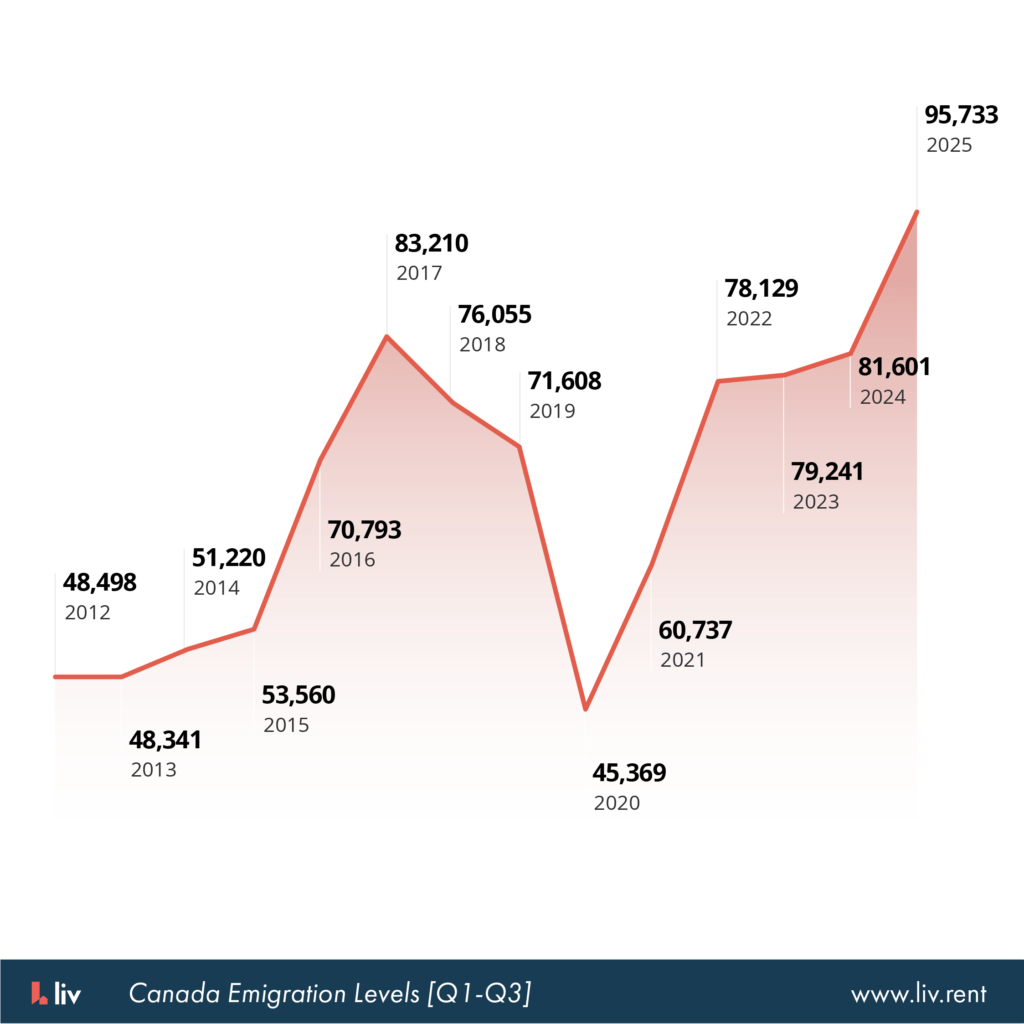
Canada sees record emigration – biggest exodus in a decade
- 11 of 13 provinces and territories post double-digit year-over-year increases in residents leaving the country.
- In 2025, 95,733 Canadians emigrated out of the country, up 17% from 2024 and the highest level since 2011.
British Columbia
B.C. stays as Canada’s third most sought-after province in Canada for immigrants
- The province attracted 13% of Canada’s immigrants, trailing Quebec at 15% and Ontario at 43%.
After a decade of growth, B.C.’s population reverses course
- For the first time since 2012, British Columbia posted negative population growth in 2025, alongside Ontario as the only provinces to decline.
B.C. among four provinces to see decline in housing starts
- Housing starts in British Columbia fell 5% year-over-year in 2025, making it one of only four provinces to record a decline.
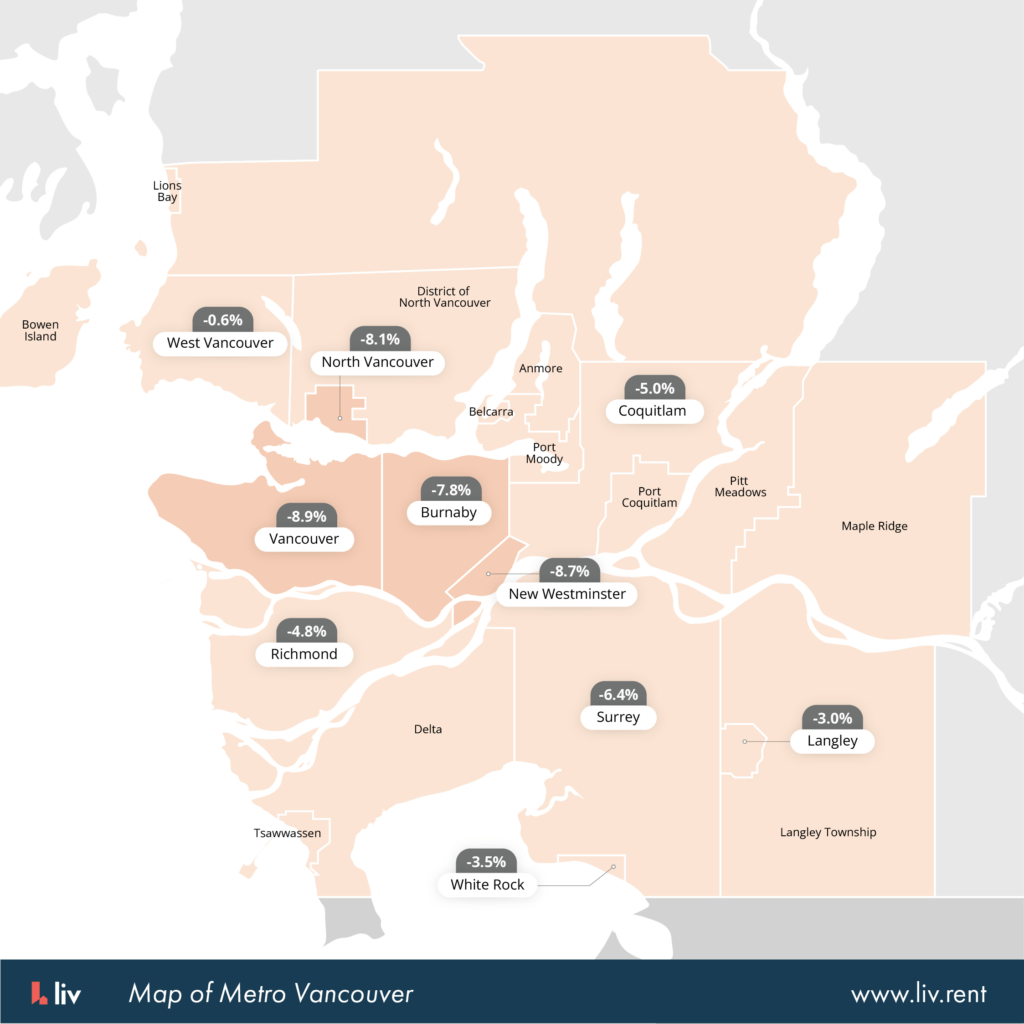
Metro Vancouver rents decline amid rising emigration
- Metro Vancouver began experiencing steeper downward pressure on rents in August 2025, coinciding with a 50% increase in emigration from B.C. in Q3 compared to Q2.
Alberta
Alberta’s migration boom is cooling after years of strong growth
- The pace of inflows has slowed markedly, with the number of Canadians moving to the province down 16% year-over-year—from 77,761 in 2024 to 65,573.
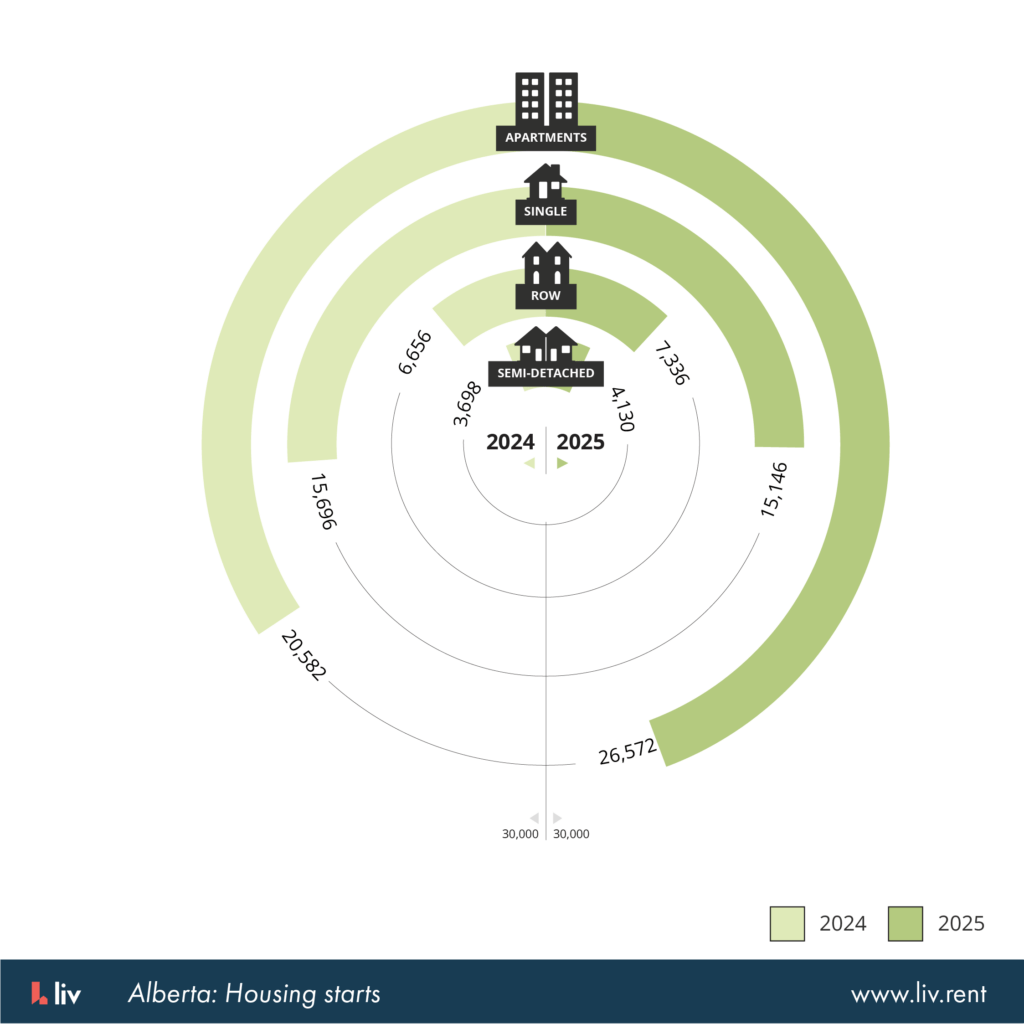
Alberta drops to third nationally in housing starts
- Alberta’s growth was driven primarily by apartments, with starts up 29%, while single-family construction declined 4%.
Following growth in 2024, Calgary rents reversed course in 2025
- Calgary rents declined year-over-year across all unit types in 2025, with two-bedroom units recording the steepest drops.
Ontario
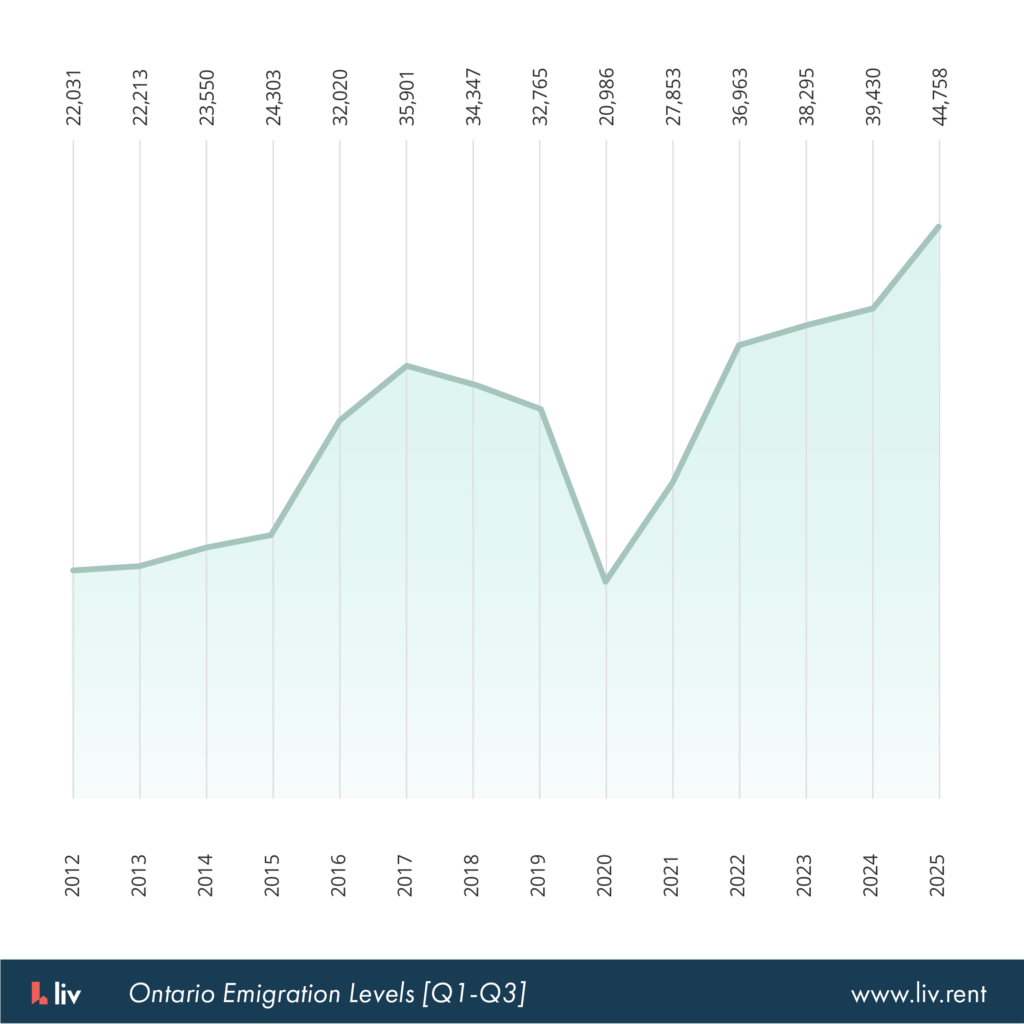
Ontario fuels Canada’s emigration as departures hit a new high
- 2025 set a new record, with 44,758 people leaving the province, a 14% year-over-year increase. Ontario continues to lead Canada in emigration, accounting for 47% of all departures nationwide.
Ontario housing supply hit by double-digit drop in construction starts
- Housing starts in Ontario fell 17% year-over-year in 2025, with declines recorded across all housing types, including a 9% drop in apartment construction.
Toronto rents fall everywhere
- Toronto’s rental price decline in 2025 was driven by widespread softening across all neighbourhoods, affecting both furnished and unfurnished units.
Nova Scotia
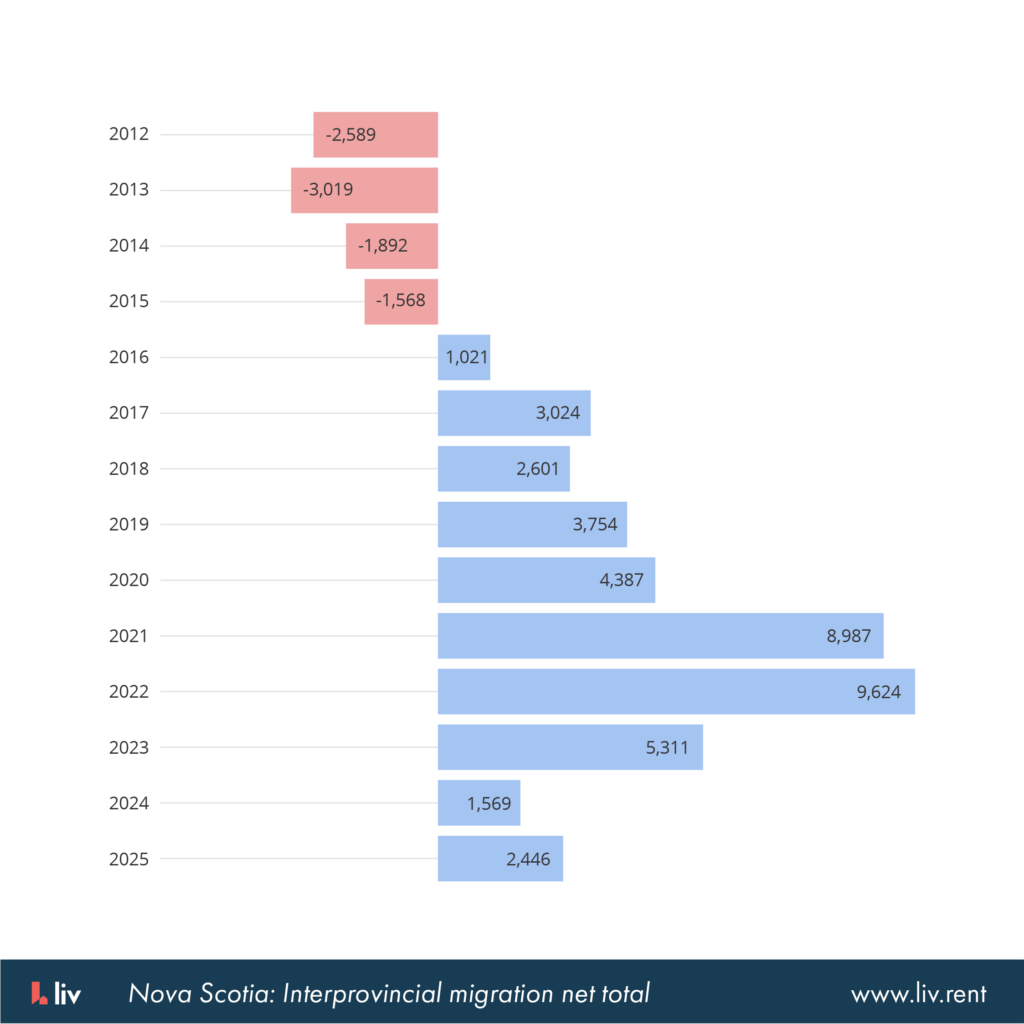
Nova Scotia trails only Alberta in interprovincial migration gains
- Nova Scotia ranked second only to Alberta in interprovincial migration gains in 2025, posting a net increase of 2,446 residents.
Nova Scotia ramps up housing starts, but completions lag demand
- Housing starts in Nova Scotia rose to 8,732 in 2025, ranking the province fifth nationally and matching Quebec’s pace of growth.
Quebec
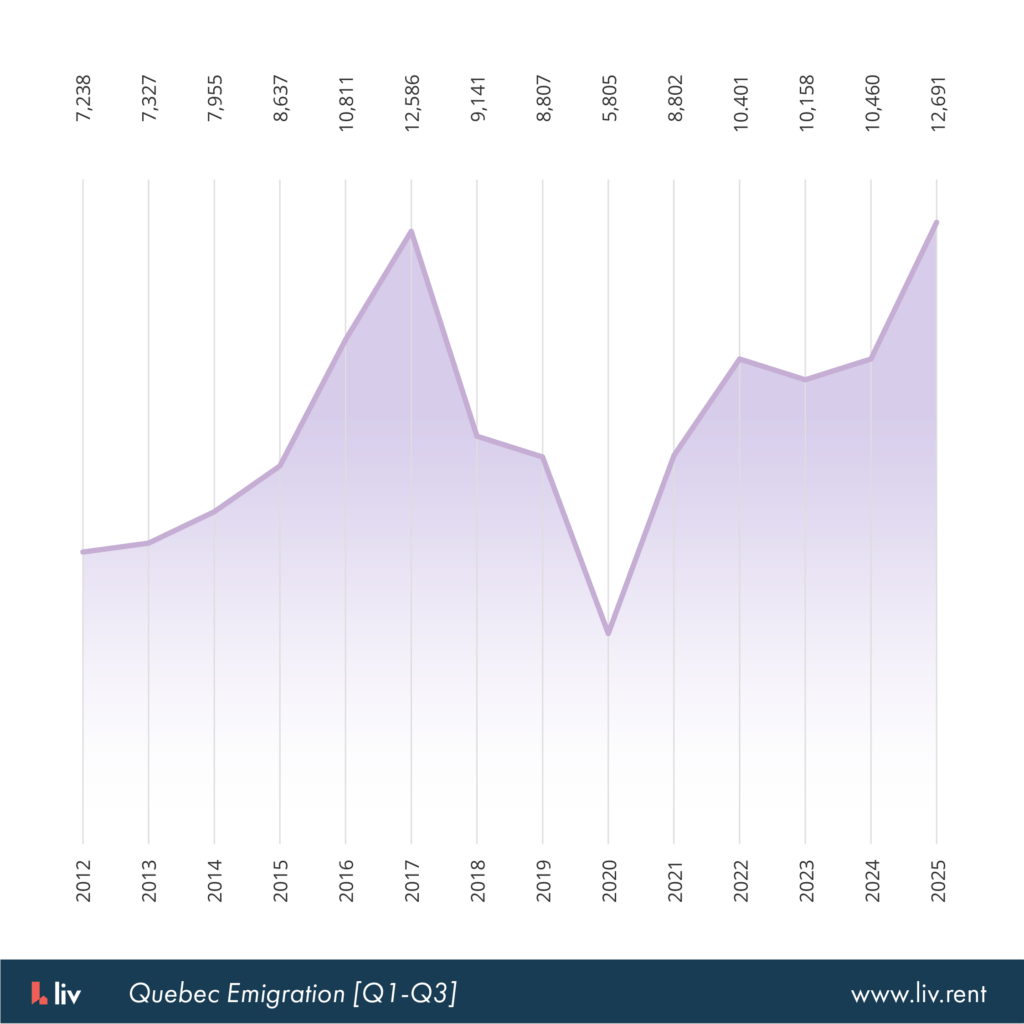
Emigration accelerates, offsetting stable immigration
- Emigration from Quebec rose sharply in 2025, increasing 21% year-over-year to 12,691 people, marking the province’s highest level since 2017 and outpacing the national increase.
Quebec leads Canada in housing starts
- Quebec emerged as one of Canada’s strongest housing markets in 2025, with housing starts jumping 32% year-over-year.
Montreal rents surge above 2024 levels, then plunge after August
- Despite broader downward pressure on rental prices, Verdun and Westmount recorded consistent year-over-year rent increases across most unit types.
Landlords-Renters: Divided Opinions
As an added bonus, we surveyed more than 750 renters and landlords to understand their perspectives on today’s rental landscape and the evolving role of AI.
- Nine in ten renters believe landlords are profitable.
- 43% landlords report that current rents do not cover expenses.
- Only one in six renters and landlords use AI.
Download the full report to view all of the in-depth insights.
Data Collection Methodology
The 2026 liv.rent Rental Market Trend Report uses data from liv.rent listings, as well as data manually collected from other popular rental listing platforms. Our methodology focuses exclusively on current asking rent prices. Unlike some government reports that include data for entire buildings (which may include long-term rent-controlled units), our analysis reflects real-time market conditions and active listing prices.
For influencing market factors, liv.rent references data from trusted sources such as Statistics Canada, Canada.ca, and CMHC, along with relevant reporting from established Canadian media outlets.
For more information on our data collection methodology, including what types of rental housing we look at, please consult the full reports.
Download the free 2026 liv.rent Rental Market Trend Report here for complete information on average rent prices and driving factors for B.C., Ontario, Alberta, and Quebec.
Unlock exclusive insights into Canada’s rental market
Download the full 2026 Rental Market Trend Report for in-depth insights and forecasts on average rent prices, regional market comparisons, key economic drivers, and emerging AI trends shaping Canada’s rental landscape.

Rethink The Way You Rent
Not on liv.rent yet? Experience the ease of digital applications & contracts, verified tenants & landlords, virtual tours and more – all on one platform. Sign up for free or download the app.
Subscribe to receive the latest tenant & landlord tips and get notified about changes in the Canadian rental market.
>> Stay up-to-date on the average rent in Vancouver, Toronto and Montreal: Rent Reports.




0 Comments